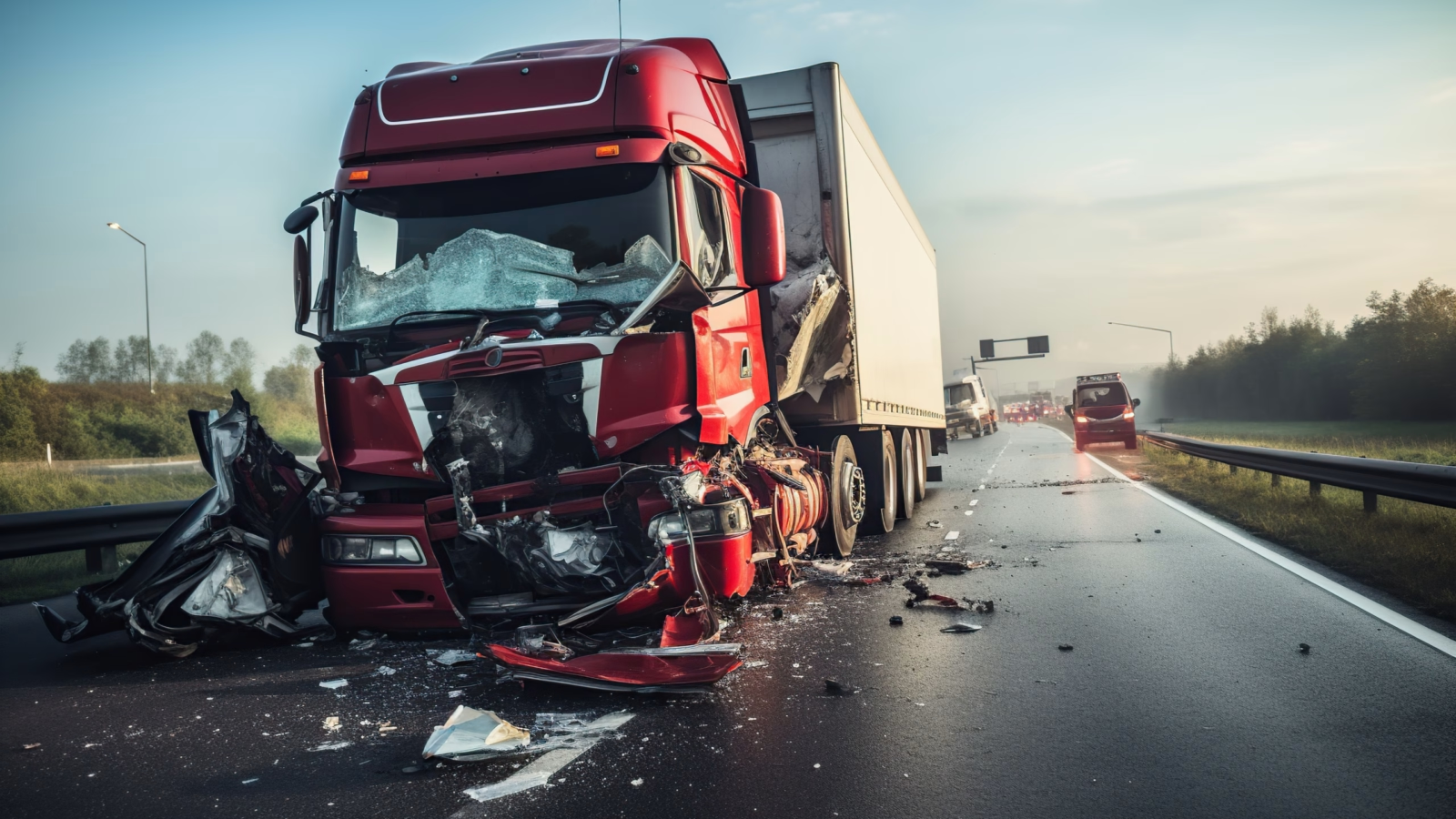
Ask anyone who commutes in metro Atlanta to name the worst stretch of road, and you will hear the same two answers: the Perimeter, and Spaghetti Junction.
The Tom Moreland Interchange — where I-285 meets I-85 in northern DeKalb County — earned its nickname honestly. Five levels of ramps, flyovers, and collector-distributor lanes carry, by GDOT’s count, more than 300,000 vehicles a day. A very large share of them are tractor-trailers, because I-285 is the freight artery that lets long-haul carriers skirt downtown on their way between I-75, I-85, and I-20.
When one of those trucks is involved in a crash, the result is rarely a fender-bender. And the case that follows is rarely simple.
Why I-285 and Spaghetti Junction Produce Such Severe Truck Crashes
The interchange is not dangerous because Atlanta drivers are worse than anyone else’s. It is dangerous because of how it is built and what moves through it.
Short weave zones. Drivers entering from one highway must cross several lanes in a very short distance to reach their exit. An 80,000-pound tractor-trailer cannot execute that maneuver the way a sedan can — it needs more space, more time, and a wider turning path. Merging conflicts here are constant.
Large speed differentials. Through-traffic on I-285 often moves at 65–70 mph while vehicles feeding in from the I-85 ramps enter well below that. Sudden braking in dense traffic is the norm, and a loaded truck’s stopping distance can be roughly 40% longer than a passenger car’s.
Blind spots that swallow cars. The “no-zones” along a tractor-trailer’s right side and directly behind it are exactly where merging traffic ends up in a multi-lane weave.
Congestion plus construction. Ongoing GDOT work along the Perimeter shifts lanes, narrows shoulders, and changes patterns from month to month. Drivers relying on memory instead of signage cause chain reactions.
Weather. Reporting on national crash patterns has repeatedly flagged the I-85/I-285 interchange as one of the U.S. locations where commercial-vehicle crash rates climb sharply in winter conditions — a function of ramp grades, elevated flyovers that ice before surface roads, and drivers unaccustomed to it.
Put together, the typical Spaghetti Junction truck crash is a high-speed, multi-vehicle event, and the people in the passenger cars absorb nearly all of the harm.
The Injuries These Crashes Cause
The physics are unforgiving. A fully loaded tractor-trailer can weigh twenty to thirty times what a passenger vehicle weighs. Underride collisions, jackknifes across multiple lanes, and rollovers on curved flyover ramps produce the most severe injuries our firm sees:
- Traumatic brain injuries, including injuries that do not appear on an initial CT scan
- Spinal cord injuries and paralysis
- Crush injuries, amputations, and burn injuries where fuel tanks rupture
- Other catastrophic injuries requiring lifetime care
- Fatalities, which give rise to a wrongful death claim brought by the surviving family
Who Is Actually Liable? It Is Almost Never Just the Driver
This is the point where truck cases separate from ordinary car accident claims. A commercial crash on I-285 can involve half a dozen potentially responsible parties, each with its own insurer and its own lawyers:
- The driver, for speeding, following too closely, unsafe lane changes, distraction, or fatigue.
- The motor carrier, for negligent hiring, inadequate training, pressuring drivers to beat delivery windows, or failing to monitor hours-of-service compliance. Carriers are also generally responsible for their drivers’ negligence within the scope of employment.
- The broker or shipper, where scheduling made a lawful trip impossible.
- The loading company, where cargo was improperly secured or unbalanced — a frequent cause of rollovers on curved ramps.
- The maintenance contractor, for brake, tire, or coupling failures.
- A parts manufacturer, where a defective component failed, which brings product liability into the case.
- A government entity, where signage, lane markings, or a construction work zone contributed. Note that claims against a city, county, or GDOT carry their own short notice deadlines — see our guide to suing a government entity in Atlanta and the ante litem notice.
Our broader guide on who is liable in a truck accident in Georgia walks through how these theories fit together.
The Evidence That Wins These Cases Disappears Fast
Federal regulations require motor carriers to keep certain records — but only for defined periods, some as short as six months. Meanwhile the carrier’s rapid response team is often at the scene within hours, photographing, measuring, and interviewing before the injured person has left the hospital.
What we move to preserve immediately:
- Electronic logging device (ELD) data — hours of service, duty status, and whether the driver was legally on the road
- The engine control module (“black box”) — speed, throttle, brake application, and hard-braking events in the seconds before impact
- Dashcam and forward-facing camera footage, and any inward-facing driver monitoring
- Post-crash drug and alcohol testing, which FMCSA rules require in defined circumstances
- Driver qualification file — licensing, medical certification, prior violations, training records
- Maintenance and inspection records, including pre-trip inspection reports
- Bills of lading and dispatch records, which reveal scheduling pressure
- GDOT traffic camera footage from the interchange, which is not retained indefinitely
A spoliation letter sent within days is what stops routine destruction of this material. Sending it in month four is often too late.
What to Do After a Truck Crash on the Perimeter
- Call 911 and get a police report. Depending on where on I-285 you are, the responding agency may be Georgia State Patrol, DeKalb County, Sandy Springs, Dunwoody, Brookhaven, or Chamblee — and the report may take days to become available.
- Photograph everything you safely can, including the tractor and trailer’s DOT numbers, company markings, and the trailer’s license plate. Tractors and trailers frequently belong to different companies.
- Get medical attention the same day. Adrenaline masks spinal and head injuries, and a treatment gap is the first thing an insurer will use against you.
- Do not give a recorded statement to the trucking company’s insurer. Their adjuster is not neutral.
- Keep your own records — mileage to appointments, missed work, out-of-pocket costs.
Our general checklist on what to do immediately after a car accident in Atlanta applies here too, with the added urgency that comes from a corporate defendant.
How Georgia Law Shapes Your Recovery
Georgia is an at-fault state, so the trucking company’s insurer pays for the harm its insured caused — a system we explain in how Georgia’s at-fault car insurance system affects your injury claim. But fault is rarely conceded in a multi-vehicle interchange crash. Expect the carrier to argue that another driver, or you, caused or contributed to the collision.
That matters because of Georgia’s modified comparative fault rule: your damages are reduced by your percentage of fault, and you recover nothing if you are found 50% or more at fault. In a five-car pileup at Spaghetti Junction, apportionment is the whole ballgame — which is why reconstruction and black-box data matter more here than almost anywhere else.
Talk to an Atlanta Truck Accident Lawyer
Thomas Kennedy Sampson & Tompkins LLP has tried serious injury cases in Georgia for more than 50 years. We know what a Perimeter truck crash file has to contain, and we know how quickly the evidence that proves it goes away.
If you or a family member was injured by a commercial truck on I-285, at Spaghetti Junction, or anywhere in metro Atlanta, contact us for a free consultation or call (404) 688-4503. No fee unless we recover for you.
Frequently Asked Questions
Why is Spaghetti Junction so dangerous? The Tom Moreland Interchange combines very high volume — GDOT puts it above 300,000 vehicles a day — with short weave distances, large speed differentials between through-traffic and merging ramp traffic, and heavy commercial truck use. Those conditions produce multi-vehicle, high-speed collisions.
Who investigates a truck crash on I-285? It depends on the exact location. Georgia State Patrol handles many interstate crashes, but DeKalb County, Sandy Springs, Dunwoody, Brookhaven, and Chamblee police also work sections of the Perimeter. A serious crash may also draw an FMCSA or GDOT review.
How long do I have to file a truck accident claim in Georgia? Generally two years from the date of injury, and two years for wrongful death. If a government entity is involved, a much shorter ante litem notice deadline applies. See our guide on how long you have to file.
Can I still recover if I was partly at fault for the crash? Yes, as long as you are less than 50% at fault. Your recovery is reduced in proportion to your share of the blame.
What is a black box, and can the trucking company erase it? The engine control module records speed, braking, and throttle data in the moments before impact. It can be overwritten or lost when the vehicle is repaired or scrapped, which is why a preservation letter needs to go out immediately.
How much is an I-285 truck accident case worth? It depends on the severity of the injuries, the medical care required, lost earning capacity, and the available insurance coverage — commercial policies are typically far larger than personal auto policies. Our guide on what a Georgia injury case is worth explains the components.
Editorial note: this post is general information about Georgia law and is not legal advice. Traffic and crash figures cited are from publicly reported GDOT data.