
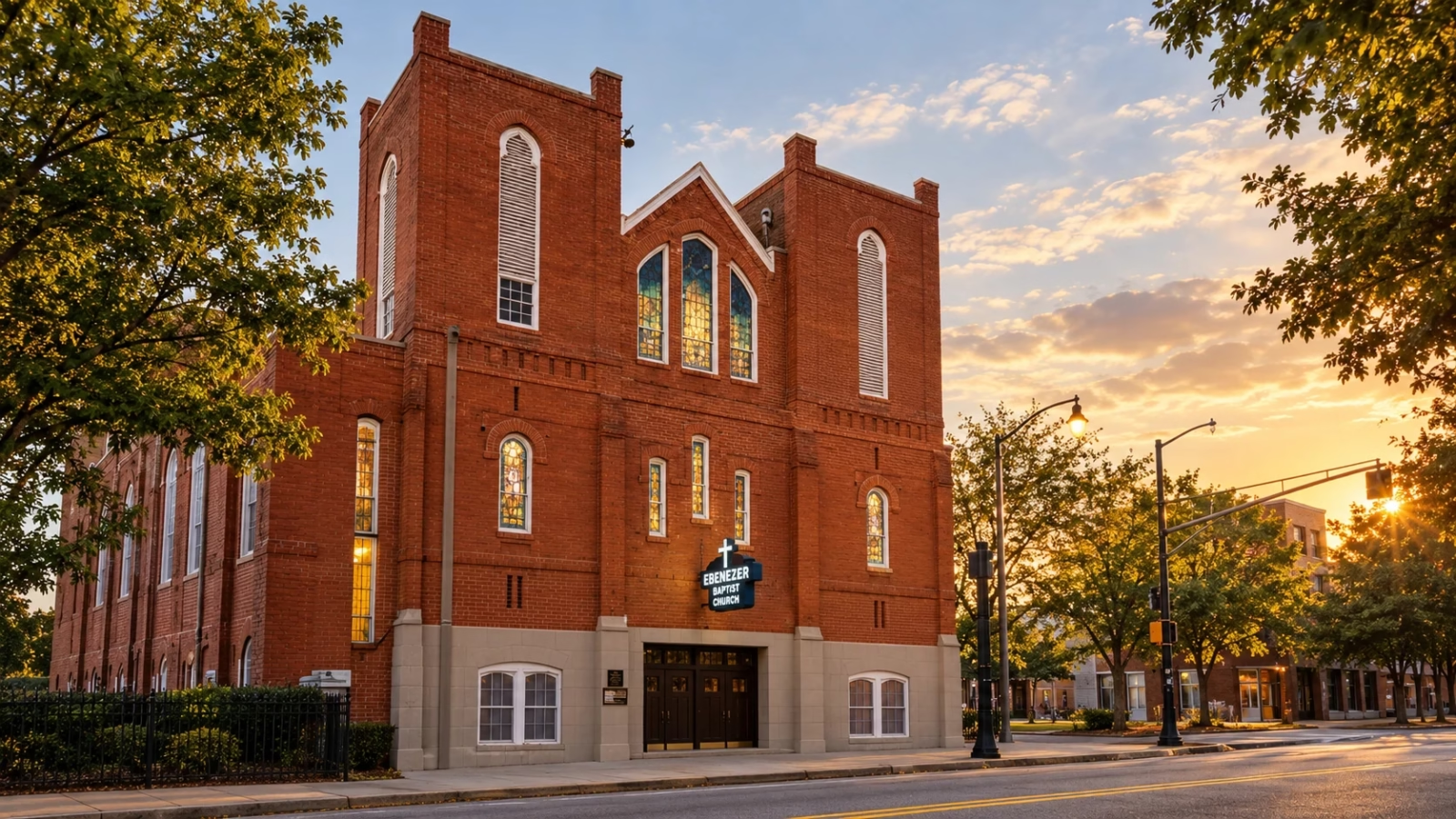
AI-generated illustration of historic Ebenezer Baptist Church in Atlanta’s Sweet Auburn district.
Searching for a Black lawyer in Atlanta, GA can be about more than finding a name in a directory. It can mean looking for experience, trust, cultural understanding, and an advocate who takes your concerns seriously. That search also connects to a Georgia history: attorneys who challenged exclusion, defended civil rights, and built institutions that expanded access to justice.
Thomas Kennedy Sampson & Tompkins LLP, known as TKST Law, belongs to that continuing story. Founded in 1971, Georgia’s oldest Black-owned law firm has served individuals, businesses, and public institutions across generations. Understanding that legacy requires looking at both the progress Black lawyers helped achieve and the disparities that remain.
Black legal history in Georgia: opening the courthouse doors
Black legal history is part of Georgia’s legal history, not a separate system of law. It includes the struggle to enter the profession, represent clients, participate in public life, and make constitutional promises meaningful. A license to practice was itself a hard-won opportunity when racial exclusion shaped education and professional advancement.
1878: Styles Linton Hutchins and the early pioneers
The Georgia Bar Journal’s account of the state’s first Black lawyers identifies Styles Linton Hutchins, admitted in 1878, as Georgia’s first African American attorney. The article also corrects histories that overlook early Black practitioners or assign that distinction to later lawyers. Preserving the record matters: exclusion should not be repeated through historical omission.
Born in Lawrenceville, Hutchins studied at Atlanta University and pursued a legal education in South Carolina before entering Georgia’s bar. His path illustrates how Black professionals often had to move across institutions and state lines to obtain opportunities. These pioneers made later careers possible, even when their own achievements received limited recognition.
1919–1948: building Atlanta’s Black legal community
Austin Thomas Walden brought his law practice to Atlanta in 1919 after military service. As the New Georgia Encyclopedia’s biography of A. T. Walden explains, he combined legal practice with civic leadership.
The Gate City Bar Association’s history of its founders records that ten African American attorneys organized the association in Walden’s office on January 25, 1948. Its founders included Rachel Pruden Herndon, Georgia’s first Black woman attorney, and Roscoe E. Thomas Jr., whose career connected civil-rights advocacy with representation of Black financial institutions.
Building a bar association meant creating a place to exchange knowledge, support professional growth, and serve communities. That institution-building remains an important part of what representation means: opening pathways for the next attorney, judge, or law student, alongside handling the next case.
The civil-rights era: turning advocacy into legal change
Georgia’s civil-rights movement depended on organizing, courage, and skilled legal work. Donald Hollowell’s career shows how those efforts intersected. He represented student demonstrators, defended Martin Luther King Jr., and helped litigate the case that desegregated the University of Georgia in 1961.
These cases required more than a compelling speech. Lawyers developed records, challenged government decisions, pursued court orders, and stood beside clients under intense pressure. Their work helped translate demands for equality into enforceable legal decisions. It also demonstrates why civil rights and the practical craft of litigation belong in the same historical conversation.
Hollowell’s influence continued beyond those landmark cases. In 1966, he became the first African American regional director of a major federal agency when appointed to lead the southeastern office of the Equal Employment Opportunity Commission. His career also included mentoring younger lawyers and activists. That movement between litigation, public service, and professional development helps explain the breadth of Black legal leadership in Georgia. Progress depended on people willing to build institutions as well as challenge them.
Why Ebenezer Baptist Church belongs in this story
Few Atlanta landmarks connect generations as clearly as historic Ebenezer Baptist Church in Sweet Auburn. According to the National Park Service’s history of Ebenezer, Dr. King became co-pastor with his father in 1960 and served until his death in 1968. The historic sanctuary places the city’s civil-rights history in a recognizable, physical setting.
For this article, the church represents the relationship among community institutions, public leadership, and the pursuit of justice. It also has a specific TKST connection: Jeffrey E. Tompkins’ professional biography identifies his service as general counsel for historic Ebenezer Baptist Church. The landmark is part of the community the firm serves.
TKST Law’s legacy: a Black-owned Atlanta firm since 1971
TKST’s history is documented outside its own website. The Gate City Bar Association’s March 2021 anniversary feature identifies John L. Kennedy, Reuben T. Bussey Jr., and Thomas G. Sampson Sr. as the firm’s 1971 founders. Its fifty-year retrospective describes a practice whose influence extends into professional leadership and Georgia’s courts.
At that anniversary, Gate City reported thirteen past association presidents, eight Hall of Fame members, and ten former firm lawyers who had become judges in Georgia’s Superior, State, and Magistrate Courts. These are historical figures reported in 2021, not a newly audited count. They show one measurable dimension of a legacy built through mentorship.
Gate City also credited the presidency of Thomas “Woody” Sampson II with the beginning of its Summer Associate Program. That connection gives the firm’s history a forward-looking dimension: experienced lawyers helping students gain access to the profession and develop practical skills.
The association’s memorial tribute to Thomas G. Sampson Sr. describes his teaching, civic service, and place in Georgia’s Black legal community. TKST’s own tribute to its co-founder preserves that story for clients and future generations.
Today, readers can learn about Thomas “Woody” Sampson II’s civil litigation experience and Jeffrey Tompkins’ work in state and federal courts. Both biographies describe experience serving individuals and institutional clients. A longstanding firm’s history is valuable context, while the fit between an attorney’s experience and a particular legal problem remains essential.
What the statistics reveal about unequal outcomes
History explains how barriers developed. Data helps show where gaps persist. The following findings measure different things: professional representation, access to assistance, criminal sentencing, and health outcomes. They should not be combined into a single claim about Georgia lawsuits or the settlement value of a Black client’s case.
Representation in the legal profession
The American Bar Association’s 2024 demographic figures put Black lawyers at approximately 5% of U.S. lawyers, compared with 13.7% of the U.S. population. The reported lawyer share was also 5% in 2014. These national figures describe underrepresentation in the profession; they do not measure an individual attorney’s skill or success rate.
For someone seeking an African American attorney in Atlanta, this context helps explain why professional visibility and mentoring matter. It also makes TKST’s documented history of developing lawyers and judicial leaders relevant beyond the age of the firm itself.
Access to help in civil matters
The Legal Services Corporation’s 2022 Justice Gap income comparison, using its 2021 survey, found that low-income Americans received no legal help or insufficient help for 92% of civil legal problems with substantial impact. The comparable figure for higher-income Americans was 78%.
This is a national income comparison, not a Black-versus-white result or a Georgia trial statistic. It nevertheless shows why access matters before a case ever reaches court. Being able to identify a problem, understand available options, and obtain appropriate assistance can determine whether a person meaningfully pursues a remedy.
Documented differences in federal sentencing
The U.S. Sentencing Commission’s 2023 study examined fiscal years 2017–2021. After accounting for available factors, Black men were 23.4% less likely to receive probation than white men. Among cases involving imprisonment, Black men received prison terms 4.7% longer.
These findings concern federal criminal sentencing nationwide. They are not estimates for Atlanta personal injury cases, and they do not establish that a lawyer’s race caused an outcome. Their relevance is narrower: measurable disparities can persist within legal institutions, making careful examination of fairness necessary.
Health disparities and the need for careful investigation
The CDC’s final 2024 maternal mortality report, published in March 2026, reported 44.8 maternal deaths per 100,000 live births among Black non-Hispanic women, compared with 14.2 among white non-Hispanic women nationally. That is approximately 3.2 times the rate, calculated from the published figures.
Georgia’s 2020–2022 maternal mortality fact sheet separately reported 141 pregnancy-related deaths, with 87% judged to have had at least some chance of prevention. Georgia’s review includes pregnancy-related deaths through one year; the CDC measure uses a 42-day window. These datasets are not directly interchangeable.
A disparity or preventability finding does not, by itself, establish medical malpractice. An individual claim requires examination of the care provided, causation, applicable legal requirements, and supporting evidence. Families seeking answers can learn about TKST’s Georgia medical malpractice representation without assuming that every adverse medical outcome creates a lawsuit.
Reading outcome statistics responsibly
Ask three questions when evaluating any statistic: Who was studied, what was measured, and when? A national study may reveal a serious concern without describing every Georgia community. A percentage of legal problems differs from a percentage of people. A sentencing difference is not a prediction about a civil jury. Those distinctions help readers understand the evidence without minimizing what it shows.
The sources cited here do not establish that Black plaintiffs receive a particular percentage less compensation in Atlanta, or that choosing an attorney of a particular race changes recovery by a fixed amount. Making either claim would require different evidence. Responsible advocacy begins with taking unequal treatment seriously while being precise about what available research can support.
Choosing a Black lawyer in Atlanta, GA
Cultural understanding can be important to the attorney-client relationship. So can feeling comfortable discussing sensitive experiences or asking difficult questions. Shared identity, however, is one consideration among several. Clients deserve clear information about relevant experience, communication, resources, fees, and the proposed approach to their matter.
Start with the legal issue. A civil-rights claim, a catastrophic injury, and a business dispute may require different experience. TKST’s Atlanta civil rights attorney page explains that practice, while its catastrophic injury resource addresses a different category of serious harm.
During a consultation, ask who will handle the matter, how the team evaluates evidence, and how updates will be provided. Ask about potential costs and the written fee agreement. Explain any approaching deadlines and bring relevant documents. A useful consultation should help you understand the next step and the questions that still need investigation.
Consider the details that matter in your own life. You may need a reliable point of contact while recovering, an explanation that family members can understand, or a lawyer prepared to discuss concerns about being dismissed or misunderstood. Raise those needs directly. The conversation should leave room for your questions, including questions about uncertainty. A firm’s legacy is most useful when it informs the quality of that present relationship: careful listening, understandable guidance, and attention to the facts that make your situation distinct.
Questions Atlanta readers often ask
What is Georgia’s oldest Black-owned law firm?
Thomas Kennedy Sampson & Tompkins LLP was founded in 1971 and is recognized as Georgia’s oldest Black-owned law firm. Its history includes service to individual clients, businesses, and public institutions, together with a documented record of mentorship and bar leadership.
Does hiring a Black attorney guarantee a better result?
No. An attorney’s race does not guarantee a verdict, settlement, or other outcome. Relevant experience, preparation, evidence, legal standards, and the circumstances of the matter all require consideration. Trust and communication matter, but promises about guaranteed results should not replace a careful case assessment.
Where should someone begin with TKST?
Review the firm’s relevant practice area and attorney biographies, then contact TKST Law for a consultation or call (404) 688-4503. Describe the issue and any known deadlines so the team can assess the appropriate next step. Georgia’s Black legal legacy continues through the everyday work of listening, preparing, and advocating.
This article offers historical context and general information, not advice about a specific claim. Past results do not guarantee future outcomes. Sources identify their own reporting periods and populations; readers can follow the linked research to examine the underlying definitions, findings, and limitations in detail.

Add a Comment