
Camp Creek Parkway and Old National Highway: Why Crashes on South Fulton’s Busiest Roads Are Harder to Resolve
Camp Creek Parkway and Old National Highway are the two roads that hold South Fulton together. Camp Creek runs west from the airport as State Route 6, past the retail district, out toward the interstate. Old National runs south through one of the most active business corridors in the county. Between them, they carry commuters, airport workers, freight, delivery vans, transit riders, and a great many people on foot.
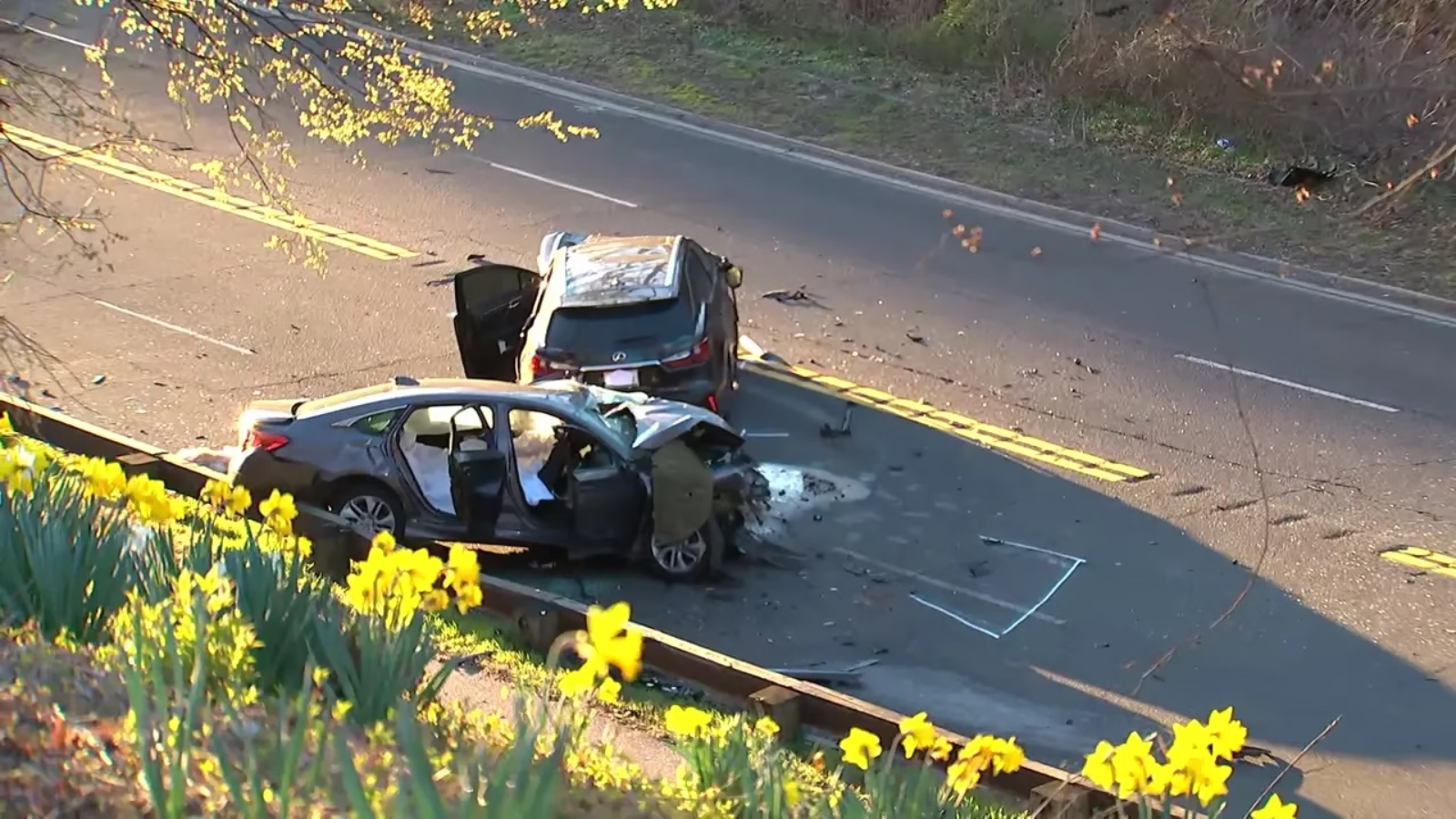
They also produce a steady volume of serious collisions, including fatal pedestrian crashes and hit-and-runs that have drawn repeated local news coverage — several of them at intersections near Old Fairburn Road and where Old National meets Jonesboro Road.
What makes claims on these two roads genuinely difficult is not proving that a crash happened. It is figuring out who you are actually suing, because the answer changes depending on which block you were standing on.
The Jurisdictional Problem
These corridors pass through, or alongside, at least four different governmental jurisdictions — and if roadway design, signal timing, lighting, signage, or maintenance contributed to your crash, you are on a notice clock that is much shorter than you think.
- The City of South Fulton. Incorporated in 2017 and now one of Georgia’s largest cities by population, it covers much of the Old National Highway business district. A claim against a Georgia municipality generally requires ante litem notice within six months.
- East Point and College Park. Separate cities, separate police departments, separate six-month clocks, and their limits sit close to the eastern end of the Camp Creek corridor.
- Fulton County. Unincorporated segments and county-maintained infrastructure remain in the mix. County claims generally carry a twelve-month notice requirement.
- Camp Creek Parkway is a state route, which puts the Georgia Department of Transportation in play on design and maintenance questions, under the Georgia Tort Claims Act and its own notice rules.
This is the same trap we wrote about in our guide to suing the City of Atlanta and the six-month deadline most people miss — except here there are four possible answers instead of one, and getting it wrong can mean serving notice on an entity that was never responsible for that stretch of road. When the right entity is unclear, the conservative approach is to identify every candidate early and notice each of them within the shortest applicable deadline.
Why These Roads Produce the Crashes They Do
Arterial speeds through a place people walk
Both corridors were engineered to move vehicles quickly between the airport, the interstates, and the residential south metro. What developed along them is dense: apartments, strip retail, restaurants, bus stops. That is the same design mismatch we described on Buford Highway — wide, fast roads with long distances between signalized crossings, and people who need to get to the other side anyway. Survival odds for a struck pedestrian drop sharply above roughly 30 mph, and these are not 30 mph roads.
Airport freight and commercial traffic
Camp Creek in particular carries air cargo, logistics, and delivery traffic feeding the Hartsfield-Jackson area. Commercial vehicles bring higher masses, longer stopping distances, and an entirely different claims process — federal safety regulations, driver qualification files, hours-of-service data, and rapid-response defense teams. See our truck accident practice and who is liable in a truck accident in Georgia. Many of the same dynamics we covered in truck accidents on I-285 and at Spaghetti Junction apply here on a smaller scale.
Night driving and impaired driving
A large share of the corridor’s most serious crashes happen after dark, where uneven lighting, wide crossings, and impairment compound each other. If a drunk driver caused your crash, Georgia also allows claims against the establishment that overserved them in some circumstances — see our drunk driving accident practice.
Drivers who leave
Hit-and-run is a recurring feature of both corridors, and it is the scenario where people most often assume they have no case. They usually do. Uninsured motorist coverage on your own policy — or a resident relative’s — frequently carries the claim even when the driver is never identified, and that applies to pedestrians and cyclists too. See our hit and run accident practice.
The ‘They Weren’t in a Crosswalk’ Defense
In pedestrian cases on these roads, the insurer’s position is predictable: your client crossed mid-block, so this is their own fault. Georgia law is more balanced than that argument suggests.
Under O.C.G.A. § 40-6-91, drivers must stop and remain stopped for a pedestrian crossing within a crosswalk — including unmarked crosswalks at intersections, a point adjusters routinely skip past. Under § 40-6-92, a pedestrian crossing elsewhere must yield, but that is a duty, not an automatic bar to recovery. Georgia applies a modified comparative fault rule: your damages are reduced by your percentage of fault and you are barred only if you are 50% or more responsible.
Meanwhile the driver owes an independent duty of due care. Speed, distraction, impairment, and a roadway that offered no reasonable crossing for half a mile all shift the allocation. Our pedestrian accident attorneys build these cases with roadway design evidence and sight-distance analysis rather than arguing about the crosswalk alone.
Who May Be Liable
- The at-fault driver and their liability insurer.
- The driver’s employer, if the vehicle was in use for work — including delivery and rideshare drivers, which are heavily represented on airport-adjacent roads.
- A commercial carrier or vehicle owner where a truck or cargo van was involved.
- Your own UM/UIM carrier, especially in hit-and-run or minimum-limits situations.
- A property owner whose parking lot, complex, or center funneled people into an unsafe crossing or failed to light its approaches — a premises liability
- A government entity, on design, signal, signage, lighting, or maintenance — subject to the notice deadlines above.
Crashes at these speeds produce traumatic brain injuries, spinal cord injuries, and other catastrophic injuries — and, too often, wrongful death claims.
What to Do After a Crash on Camp Creek or Old National
- Note the responding agency and get the report number. City of South Fulton PD, East Point PD, College Park PD, Fulton County, and Georgia State Patrol all work these roads. This single detail often decides which notice deadline applies to you.
- Capture the location precisely — nearest cross street, mile marker, or business address. Jurisdiction can change within a block.
- Photograph the road, not just the cars. Lighting, crosswalk distance, signal timing, sightline obstructions, pavement condition.
- Look for cameras immediately. Retail along both corridors records heavily, and most systems overwrite within days.
- Get treated the same day, and follow the rest of the checklist in what to do immediately after a car accident in Atlanta.
Talk to a South Fulton Accident Lawyer
Thomas Kennedy Sampson & Tompkins LLP has tried cases in Georgia since 1971, and our office is at 3355 Main Street in College Park — minutes from both corridors. We know which agency patrols which stretch, and we know how quickly a government notice deadline can close a case that would otherwise have been worth pursuing.
If you were hurt on Camp Creek Parkway, Old National Highway, or anywhere in South Fulton, contact us for a free consultation or call (404) 688-4503. For a broader overview of claims in this area, see our Tri-Cities injury claim guide.
Frequently Asked Questions
Who is responsible for road safety on Camp Creek Parkway? It depends on the segment. Camp Creek is a state route, which involves GDOT, while adjacent city and county governments maintain intersecting roads, signals, sidewalks, and lighting. Identifying the correct entity — and meeting its notice deadline — is one of the first tasks in these cases.
Do I really only have six months? The general statute of limitations for personal injury in Georgia is two years. But an ante litem notice to a city is generally due within six months, and to a county within twelve. If a government entity may share fault, the short clock is the one that matters. See how long you have to file a claim in Georgia.
The driver who hit me fled. What now? Report it to police promptly and notify your own insurer. Uninsured motorist coverage often provides a full recovery even if the driver is never found — including for pedestrians.
I was crossing outside a crosswalk. Is my case over? Usually not. Georgia’s modified comparative fault rule bars recovery only if you are 50% or more at fault, and driver speed, distraction, impairment, and roadway design all shift that allocation.
A truck hit me. Is that different from a car crash? Substantially. Commercial carriers are governed by federal safety regulations, maintain records that must be preserved quickly, and typically dispatch investigators to the scene within hours. These cases should be opened fast.
This post is general information about Georgia law and is not legal advice. Jurisdiction over specific roadway segments changes over time; the responsible entity in any given case must be confirmed on the facts.