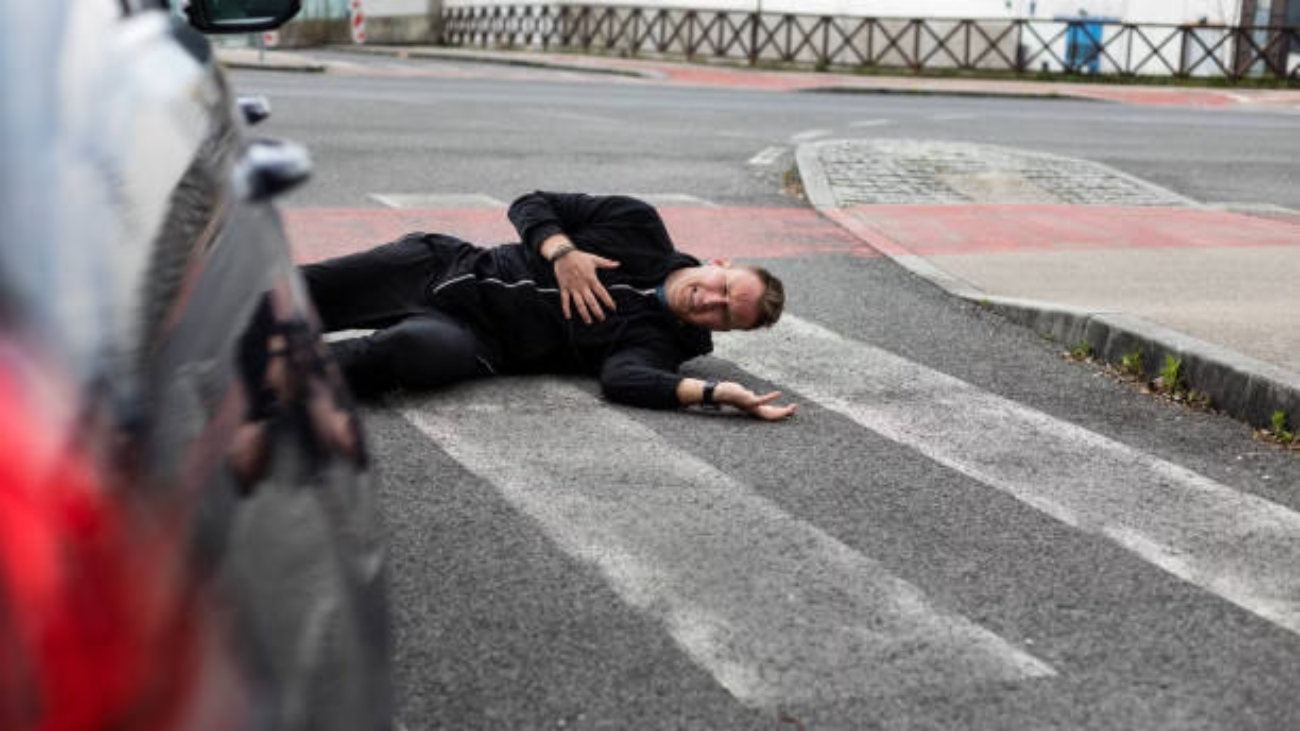
Buford Highway is one of the most vibrant corridors in metro Atlanta — miles of family-owned restaurants, groceries, and shops running through Brookhaven, Chamblee, and Doraville. It is also, by a wide margin, one of the most dangerous places in Georgia to be on foot.
The reason is a design mismatch. Buford Highway was engineered as a high-speed suburban arterial: seven lanes in places, wide travel lanes, and posted speeds that encourage faster. What grew up alongside it is a dense, walkable neighborhood where thousands of people live in apartments on one side of the road and shop, work, and catch the bus on the other. Signalized crosswalks can be spaced far apart — in some stretches, more than a half mile. Federal and state transportation reviews have repeatedly identified segments of the corridor as high-risk for pedestrians, and the U.S. Department of Transportation has singled out the DeKalb County stretch as among the deadliest in the state.
Statewide, the Georgia Governor’s Office of Highway Safety recorded 284 pedestrian deaths in 2024, down from 327 in 2023 but still far above where the state was a decade ago. A disproportionate share of those deaths happen on corridors that look exactly like Buford Highway.
If you or someone in your family was struck there, here is what you need to know.
Why Buford Highway Crashes Happen
Understanding the cause matters, because it is what defeats the insurer’s inevitable argument that the pedestrian is to blame.
- Crosswalks are too far apart. When the nearest signal is a fifteen-minute round trip away, people cross where they need to cross. Traffic engineers have understood for decades that crossing spacing drives crossing behavior.
- Speed. Survival odds for a struck pedestrian fall sharply above roughly 30 mph. Buford Highway routinely carries traffic well above that.
- Poor lighting. A large share of pedestrian fatalities nationally occur after dark, and lighting along parts of the corridor is uneven.
- Multiple-threat collisions. A driver in the curb lane stops for a pedestrian; the driver in the next lane cannot see them and does not. This is one of the most lethal patterns on multi-lane roads.
- Turning drivers. Left- and right-turning vehicles scanning for gaps in traffic frequently fail to look for people in the crosswalk they are turning into.
- Bus stops without safe crossings. Transit riders are dropped on the opposite side from their destination and have no reasonable way across.
- Hit and run. The corridor has seen repeated fatal hit-and-run crashes. If the driver fled, see our hit and run accident practice — you may still have a recovery through uninsured motorist coverage even if the driver is never found.
What Georgia Crosswalk Law Actually Says
Insurers lean hard on the word “jaywalking.” Georgia’s statutes are more nuanced than that, and the details often favor the pedestrian.
Drivers must stop for pedestrians in a crosswalk — O.C.G.A. § 40-6-91
A driver must stop and remain stopped to allow a pedestrian to cross within a crosswalk when the pedestrian is on the half of the roadway the vehicle is traveling on, or is approaching and within one lane of it. “Half of the roadway” means all lanes carrying traffic in one direction. Importantly, this applies to unmarked crosswalks at intersections as well as painted ones — a point insurers routinely gloss over.
The statute cuts both ways: a pedestrian may not suddenly leave a curb and step into the path of a vehicle so close that the driver cannot yield.
Crossing outside a crosswalk — O.C.G.A. § 40-6-92
A pedestrian crossing at a point other than a marked or unmarked crosswalk must yield to vehicles on the roadway — unless they have already, and under safe conditions, entered the roadway. Between adjacent signalized intersections, pedestrians must cross in a marked crosswalk.
Why “outside the crosswalk” does not end your case
Here is what matters most on Buford Highway: crossing outside a crosswalk is not automatically fatal to a claim. Georgia applies a modified comparative fault rule. Your damages are reduced by your share of fault, and you are barred only if you are found 50% or more responsible.
Drivers also owe an independent duty of due care regardless of where a pedestrian is. A driver who was speeding, texting, impaired, or running a red light does not get a pass because the pedestrian was mid-block. Cases turn on the comparison — and a well-documented case frequently ends with the driver carrying the larger share.
The Injuries Are Rarely Minor
A person struck by a vehicle at arterial speed has no protection at all. The cases we see on corridors like this one involve:
- Traumatic brain injuries, often from secondary impact with the windshield or pavement
- Spinal cord injuries and paralysis
- Complex fractures of the pelvis, femur, and tibia — the classic “bumper injury” pattern
- Internal organ damage and degloving injuries
- Other catastrophic injuries requiring long-term care
- Fatal injuries, giving the family a wrongful death claim
Who May Be Responsible
Most claims start with the driver, but not all of them end there.
- The driver, and their liability insurer.
- The driver’s employer, if the vehicle was being used for work — including delivery drivers and rideshare. Rideshare crashes have their own coverage layers, covered on our Uber and Lyft accident page.
- A commercial vehicle owner, if a truck or van was involved. Buford Highway carries significant delivery traffic; see our truck accident practice.
- Your own insurer, through uninsured/underinsured motorist coverage — which is often the only real source of recovery in a hit and run or where the driver carries minimum limits.
- A property owner, where a parking lot, apartment complex, or shopping center funneled pedestrians into a dangerous crossing or failed to light and maintain its approaches. That is a premises liability question.
- A government entity, where roadway design, signal timing, signage, or crosswalk maintenance contributed. This is critical on Buford Highway, because different segments fall under different jurisdictions — Brookhaven, Chamblee, Doraville, DeKalb County, and GDOT all have a role. Claims against these entities carry short notice deadlines: six months for a city, twelve months for a county or the state. Read our guide on ante litem notice deadlines for government claims in Atlanta before you assume you have two years.
What to Do After a Pedestrian Crash
Get treated immediately, even if you feel able to walk away. Head injuries and internal bleeding are frequently delayed in presentation, and a gap in treatment is the first thing an adjuster attacks.
Make sure a police report is made and note which agency responded — jurisdiction along the corridor changes city to city.
Preserve the scene. Photograph the crossing, the distance to the nearest signal, the lighting, sightlines, and any obstructions. Look for cameras: businesses along Buford Highway are densely packed, and private surveillance footage is often the best evidence of what actually happened. It is also typically overwritten within days.
Get witness contact information at the scene. Many corridor witnesses are pedestrians or transit riders who will be impossible to locate later.
Say nothing to the driver’s insurer before speaking with a lawyer. The first call is aimed at getting you to say you “came out of nowhere.”
Note whether an interpreter was used. The corridor is one of the most linguistically diverse areas in the Southeast. If a police report was taken without adequate interpretation, the narrative in that report may be wrong — and that narrative drives the insurer’s fault position from day one. It can be challenged.
Talk to an Atlanta Pedestrian Accident Lawyer
Thomas Kennedy Sampson & Tompkins LLP has represented injured Georgians for more than 50 years. Our pedestrian accident attorneys know how these cases are defended — and how to answer the “they weren’t in a crosswalk” argument with roadway design evidence, sight-distance analysis, and the driver’s own conduct.
If you or a loved one was struck on Buford Highway or anywhere in the Atlanta metro, contact us for a free consultation or call (404) 688-4503. You pay nothing unless we recover for you.
Frequently Asked Questions
Can I recover if I was not in a crosswalk when I was hit? Often, yes. Georgia uses modified comparative fault: you recover as long as you are less than 50% at fault, with damages reduced by your share. Driver speed, distraction, impairment, and roadway design all shift that allocation.
What if the driver fled the scene? You may still recover through uninsured motorist coverage on your own auto policy — or a resident relative’s policy — even though you were on foot. Report the crash to police promptly and to your insurer. See our hit and run practice.
Who is responsible for pedestrian safety on Buford Highway? It depends on the segment. Portions run through Brookhaven, Chamblee, and Doraville, portions are unincorporated DeKalb County, and GDOT has jurisdiction over the state route. Where road design or maintenance contributed, identifying the right entity — and meeting its notice deadline — is essential.
Do I have two years to file? Generally two years for a personal injury or wrongful death claim in Georgia. But if a city, county, or state agency is a potential defendant, an ante litem notice is due in six or twelve months. See how long you have to file a claim in Georgia.
Does it matter that I don’t have auto insurance? I was walking. It affects which UM coverage may be available to you, but it does not affect your right to pursue the at-fault driver. Many pedestrian clients recover fully from the driver’s liability policy.
Does immigration status affect my claim? Georgia personal injury law does not condition your right to recover on immigration status. Our conversations with you are confidential and protected by attorney-client privilege.
Editorial note: this post is general information about Georgia law and is not legal advice. Pedestrian fatality figures are from the Georgia Governor’s Office of Highway Safety.