African American family comforting one another at a theme park.

Theme Park Accidents in Georgia: Six Flags Cases and Your Legal Options

By Thomas Kennedy Sampson & Tompkins LLP • October 15, 2026

Theme park accidents raise urgent questions for Georgia families. Was a ride operated safely? Who maintained the equipment? What evidence will explain an injury? And how can a family protect its options while concentrating on medical care? The answers require more than a dramatic video or a headline about another lawsuit.

This guide examines documented Six Flags Over Georgia incidents and other serious amusement attraction cases, then explains how evidence, responsibility, and damages are evaluated. These examples are not TKST case results. Different jurisdictions and facts produce different outcomes, and no past verdict establishes what another claim is worth.

For help with a specific incident, visit our Atlanta amusement park accident lawyer page or request a free consultation.

Documented Six Flags and amusement park incidents

Six Flags Over Georgia: the October 2026 Goliath investigation

On October 12, 2026, a fatal incident occurred involving Goliath at Six Flags Over Georgia. WSB-TV reported statements from Six Flags and local officials. The park’s official update, checked October 15, said Goliath remained temporarily closed with no anticipated reopening date.

A pending investigation should not be presented as a proven restraint defect, operator error, or finding of liability. Early reports can change. Families should distinguish official findings from witness impressions and online speculation, while preserving their own evidence promptly.

Joshua Martin: a Georgia case about violence and premises liability

In Martin v. Six Flags Over Georgia II, L.P. (2017), the Georgia Supreme Court examined a 2007 attack that left Joshua Martin with permanent brain injuries. The court upheld the basis for liability although the beating occurred beyond the property boundary, because the attack began on the property. It required a new trial on apportionment rather than a complete retrial. The underlying jury verdict was $35 million.

This was a negligent-security case, not a roller coaster defect case. It illustrates why the sequence and location of events matter. It also requires a current-law qualification: Georgia’s 2025 SB 68 introduced a new statutory negligent-security framework, including location-related limitations. A historical decision cannot substitute for reviewing the rules and effective-date provisions governing a new incident.

The 2008 Batman incident: different facts require different analysis

Contemporaneous Associated Press coverage carried by 6abc reported that a teenager died after entering a restricted area and being struck by the Batman ride at Six Flags Over Georgia in June 2008. Officials reported that he crossed fences and warning signs. This was not reported as an ejection of a seated passenger.

The distinction matters. Access restrictions, warnings, visitor conduct, and the location of an injury can affect both duty and defenses. Responsible analysis should neither merge unrelated accidents nor decide a person’s legal rights from a brief news account.

Orlando FreeFall: investigation and a manufacturer’s verdict

Tyre Sampson died after falling from Orlando FreeFall in March 2022. A Florida legislative analysis discusses the tragedy and subsequent ride-safety legislation. In December 2024, AP reported a $310 million jury award against the Austrian manufacturer, which did not appear to defend the case. That report described collection as requiring additional proceedings abroad.

A verdict is not the same as money collected. This example also shows why a claim may involve more than the company operating an attraction. It does not establish an expected recovery for a Georgia family or apply Florida law to a Georgia accident.

Alton Towers: safety procedures can matter as much as machinery

The United Kingdom’s Health and Safety Executive described the 2015 Smiler collision at Alton Towers in its official enforcement release. Sixteen people were injured, including two women who suffered leg amputations. Investigators identified failures in arrangements for safety-critical decisions; the operator received a £5 million fine in 2016.

That was a British regulatory prosecution, not a Georgia civil damages award. Its practical lesson is narrower: an investigation should examine training, troubleshooting, and decision-making as well as physical components.

Who can be responsible for a theme park injury?

A park’s name does not identify every business involved in operating it. One entity may own the land, another may run the attraction, and outside contractors may perform inspections or maintenance. Manufacturers may supply seats, restraints, sensors, or control systems. Counsel must identify who controlled the relevant activity and what each party allegedly did wrong.

For premises claims, O.C.G.A. § 51-3-1 addresses an owner or occupier’s ordinary-care duty to invitees. A claimant still needs evidence connecting a breach of duty to the injury. Being hurt at a park is not, by itself, proof that the park was negligent.

A ride case may require engineering analysis of maintenance, modifications, restraint geometry, operating instructions, or dispatch practices. A walkway fall may focus on a specific hazard and knowledge of it. A violence-related claim raises separate statutory questions. Selecting the correct theory helps determine which records and experts are actually useful.

Who regulates amusement rides?

The U.S. Consumer Product Safety Commission distinguishes fixed amusement rides from mobile rides; its authority covers mobile amusement rides. Georgia’s Office of Insurance and Safety Fire Commissioner provides state amusement-ride information. Georgia law requires annual inspections of covered amusement rides and permits more frequent inspections.

An inspection certificate is evidence, not an answer to every liability question. The investigation may still need to determine what happened afterward, whether a particular component was changed, and whether staff followed the applicable procedures. Likewise, a temporary shutdown is not itself a legal finding of negligence.

What families should preserve after an accident

Medical care takes priority. Once immediate needs are addressed, preserve information already in your possession. Keep admission tickets, receipts, reservation emails, ride photographs, and messages exchanged around the incident. Write down the attraction, time, seat or location, companions, and staff members you remember. A short factual account made early can be more useful than a later reconstruction.

Save original video and photograph files rather than only edited clips or social-media versions. Original files may retain timestamps and other context. Keep a separate note of who recorded each item and how you obtained it. Do not alter an image to make an argument, and do not delete material because you think it looks unfavorable.

Ask witnesses for contact information if they are willing to provide it. Record what you personally observed separately from what someone else said. Describe uncertainty honestly: “I heard a sound” is different from identifying the mechanical part that caused it. Avoid contacting other visitors to coordinate accounts.

An attorney may consider preservation notices for surveillance, dispatch data, inspection records, training materials, maintenance logs, incident reports, and relevant components. Preservation is especially important when routine systems overwrite data. Families should not enter restricted areas, access private systems, or attempt their own equipment testing.

Why a careful timeline matters

Build a timeline that starts before the injury and continues through reporting and treatment. Include when you entered the park, joined the queue, boarded an attraction, noticed a problem, requested help, and received care. Keep a backup copy somewhere your family can access it securely. Use receipts and original photographs to check times instead of relying entirely on memory.

For a ride incident, note whether the attraction stopped, whether an attendant checked a restraint, and what instructions were given. For a fall, describe the walking surface, lighting, footwear, weather, and nearby warnings. These are observations to preserve, not conclusions about fault.

If accounts differ, retain the differences. A lawyer can compare independent evidence and identify gaps that require investigation. Rewriting an account to match a news report can obscure details that distinguish your experience from somebody else’s.

Reporting an injury versus proving a claim

Request an incident-report number and keep communications with the park or insurer. An internal report can help establish when an event was reported, but it is not necessarily a complete investigation or an admission of fault. Correct inaccurate information in your own communications without guessing at technical causes.

Before providing a recorded statement, signing a release, or accepting payment, understand what is being requested. A document described as routine may have broader consequences. Keep a complete copy of anything you sign. A refund of admission and a settlement releasing injury claims are different matters.

Catastrophic injuries require a long-term view

A serious brain injury, spinal injury, amputation, or other permanent impairment can affect far more than the first hospital bill. Families may need to evaluate rehabilitation, assistance at home, adaptive equipment, transportation, and the injured person’s ability to return to work. Treatment providers and appropriate experts can help establish likely needs rather than relying on assumptions.

Keep records of expenses and practical changes: missed work, appointments, household assistance, and activities the person can no longer perform. A contemporaneous journal can document daily impact, but it should be accurate and consistent with medical advice. Do not exaggerate symptoms or stop treatment to influence a claim.

Recoverable damages depend on the claim, evidence, and law. Financial losses and pain and suffering require different forms of support. Future losses must be evaluated carefully. Our catastrophic injury page explains the broader consequences of life-changing harm.

When an injury is fatal, wrongful death and estate claims may involve different claimants and categories of loss. Family relationships, estate administration, and the timing of events can matter. An advertised verdict from another jurisdiction should never be used as a calculator for a family’s potential recovery.

Common questions after a Georgia amusement park accident

How long do I have to file?

Georgia’s personal injury limitations statute generally provides two years. Exceptions and different claims can change the deadline. Children, public entities, and estate issues can introduce additional considerations. Reporting an incident or negotiating with an insurer should not be assumed to pause the filing period. Have the actual dates reviewed promptly.

Does a ticket waiver mean I have no case?

Not automatically. The complete language and circumstances need review, along with the type of claim and applicable law. Preserve the ticket terms, online checkout information, and any separately signed document. Neither “all waivers are enforceable” nor “waivers never matter” is a reliable answer.

What if the park blames the injured visitor?

Visitor conduct can matter. Georgia’s comparative-fault statute generally reduces damages for a claimant’s share of fault and bars recovery at 50 percent or more. Other defenses may also apply. An allegation by an insurer is not a factual determination; the evidence and governing legal standards must be assessed.

Can an injury outside a ride still qualify?

Potentially. Queues, walkways, loading areas, parking facilities, and water attractions present different risks. The important questions concern the location, legal duty, alleged failure, and causation. A claim involving an assault must also be evaluated under current negligent-security law rather than treated as an ordinary slip-and-fall.

What should I bring to a consultation?

Bring a timeline, treatment information, park communications, available photographs, and witness details. Tell the lawyer about prior injuries or conditions that may be relevant. You do not need a completed investigation. A consultation should clarify what information is missing, which deadlines matter, and whether further investigation is warranted.

Get answers grounded in your circumstances

Documented accidents can identify useful questions, but they cannot decide a new case. A sound evaluation separates known facts from allegations, identifies the responsible entities, and connects the evidence to the applicable law. Families deserve a realistic explanation of both the strengths and uncertainties.

Thomas Kennedy Sampson & Tompkins LLP offers free consultations for people seeking help after serious injuries. Contact TKST or call (404) 688-4503 to discuss your circumstances. Our premises liability practice and dedicated amusement park injury page provide additional information.

General educational information, not legal advice. Sources checked October 15, 2026; ongoing investigations may develop. TKST does not claim representation in the historical matters discussed and is not affiliated with the parks. Past outcomes do not guarantee future results. Contacting the firm does not create an attorney-client relationship.

Construction workers in hard hats working on a building site next to a crane

Hurt on an Atlanta Construction Site? Workers’ Comp May Not Be Your Only Claim

Look at the Atlanta skyline on any weekday and you will count cranes. Midtown high rises, mixed-use towers along the BeltLine, data centers, stadium and airport work, and road projects that never seem to end. All of it is built by people working at height, around heavy equipment and alongside crews employed by half a dozen different companies.

When one of those workers is badly hurt, the conversation almost always stops at four words: file for workers’ comp. For a lot of injured workers that is terrible advice, because it is only half the picture.

Workers’ compensation is the floor. On a multi-employer job site, it is very often not the ceiling.

Quick answer

Georgia workers’ compensation is an exclusive remedy against your own employer, so you generally cannot sue the company that hired you. It does not bar a claim against a negligent third party: another contractor, an equipment manufacturer, a property owner, a trucking company or a driver.

That distinction matters enormously. Workers’ compensation pays medical bills and a portion of wages but nothing for pain and suffering. A third-party claim can recover the full range of damages. Most seriously injured construction workers in Atlanta have both claims, and nobody tells them about the second one.

Construction Remains One of the Most Dangerous Ways to Earn a Living

This is not an impression. The U.S. Bureau of Labor Statistics counted 5,070 fatal work injuries nationwide in 2024. Construction and extraction occupations accounted for 1,032 of them. Falls, slips and trips alone killed 370 workers in those occupations, down from 400 the year before but still the defining hazard of the trade.

The Occupational Safety and Health Administration describes the industry the same way, listing falls from height, unguarded machinery, being struck by equipment, electrocution, silica and asbestos among the serious hazards workers face. An OSHA citation after your injury is not the same as a legal finding of liability, but it is powerful evidence, and it is public.

Who the Third Party Usually Is on an Atlanta Job Site

A modern construction project is a stack of separate companies. Your employer is one of them. Everyone else on that site is a potential defendant if their negligence injured you.

Potential third partyTypical theoryWhat the case turns on
Another subcontractorCreated the hazard that hurt you: unguarded opening, falling material, live circuit, unsafe excavationSite safety plans, daily logs, toolbox talk records, which trade controlled the area
Equipment or parts manufacturerProduct liability for a defective lift, saw, harness, ladder or scaffold componentThe physical equipment, preserved and unaltered, plus maintenance and recall history
Property owner or developerPremises liability for a dangerous condition the owner controlledWho retained control over the site and whether the owner knew about the hazard
Crane, rigging or scaffold companyNegligent erection, inspection or operation by a separate specialty contractorInspection certificates, operator certification, rigging plans
Trucking company or driverDelivery or haul truck strikes a worker, or a crash occurs in a work zoneELD and black box data, dispatch records, see our truck accident practice
Engineer or architectNegligent design, though Georgia extends comp immunity to certain construction design professionalsThe contract scope and whether the immunity provision applies

The Statutory Employer Trap

Here is the part that catches even experienced lawyers. Georgia does not limit workers’ compensation immunity to the company that signs your paycheck.

Under the statutory employer doctrine, a principal or general contractor who is liable to secure workers’ compensation benefits for a subcontractor’s employees under O.C.G.A. section 34-9-8 can also claim tort immunity, in some circumstances even where it did not actually pay the benefits. The Georgia Supreme Court applied that reasoning in Wright Associates v. Rieder, and later decisions have extended it to general contractors.

The practical consequence is that suing the general contractor is not automatic. The analysis depends on the contract chain, the project hierarchy and who genuinely carried coverage. It also cuts the other way: a contractor several steps removed from your employer, or one with no obligation to secure your benefits, may have no immunity at all. That determination should be made from the contract documents at the beginning of a case, not guessed at.

What Each Claim Actually Pays

The two systems compensate completely different things, which is why pursuing only one can leave a catastrophically injured worker short for life.

Category of lossWorkers’ compensationThird-party claim
Medical treatmentAuthorized treatment, usually through a posted panel of physiciansPast and future medical care, including care comp will not authorize
Lost wagesA statutory portion of average weekly wage, subject to capsFull lost earnings and lost future earning capacity
Pain and sufferingNot availableAvailable
Disfigurement and loss of enjoyment of lifeNot available as suchAvailable
Spouse’s loss of consortiumNot availableAvailable
Punitive damagesNot availableAvailable where the conduct justifies it
Fault requiredNo, benefits are no-faultYes, negligence must be proven

The Workers’ Compensation Lien, and the Rule That Limits It

When an injured worker recovers from a third party, the comp insurer will typically assert a subrogation lien under O.C.G.A. section 34-9-11.1 and claim reimbursement out of the settlement. Many workers are told this is automatic. It is not.

Georgia law conditions the lien on the injured worker having been fully and completely compensated for all of their economic and noneconomic losses. Where a recovery is limited by available insurance, or where the losses are severe enough that no settlement truly makes the worker whole, the lien can be reduced or defeated. Whether that argument gets made, and made well, often determines how much of a settlement the injured family actually keeps. Our guide on how personal injury settlements work in Georgia covers the mechanics of distribution.

Evidence on a Job Site Disappears Faster Than Almost Anywhere Else

A construction site is designed to change. By the time most injured workers call a lawyer, the scene that proves their case has been built over.

  • The equipment itself. A defective lift or saw gets repaired, returned to a rental company or scrapped. Once it is altered, the product case is usually gone. A preservation letter has to go out immediately.
  • Site conditions. The unguarded opening gets covered, the scaffold is struck, the excavation is backfilled. Photographs taken in the first days are irreplaceable.
  • Daily logs, toolbox talks and safety meeting sign-ins. These establish who controlled the area and what hazards were known.
  • Subcontracts and insurance certificates. These determine who is a statutory employer, who is a true third party and which policies are available.
  • The OSHA investigation file. Useful, and obtainable, but it moves on its own timeline and is not a substitute for your own investigation.
  • Witnesses. Crews rotate off projects and move between states. Names and phone numbers taken on day one are worth more than any document.

The Injuries These Cases Involve

Falls from height, crush injuries, electrocutions and struck-by events rarely produce minor harm. The construction cases our firm handles typically involve traumatic brain injuries, spinal cord injuries and paralysis, burn injuries from electrical contact or flash fire, amputations and other catastrophic injuries requiring lifetime care. When a worker is killed, the family may bring a wrongful death claim alongside the comp death benefit, and our guide on who can file a wrongful death claim in Georgia explains who holds that right.

If You Are Undocumented or Paid in Cash

Two things injured workers in Atlanta are regularly told, both wrong. First, that immigration status bars a claim. Georgia personal injury law does not condition the right to recover on immigration status. Second, that being paid in cash or issued a 1099 means there is no workers’ compensation. Georgia looks at the substance of the working relationship, not the label, and misclassified workers are frequently employees in fact. Conversations with our attorneys are confidential and protected by attorney-client privilege.

Frequently Asked Questions

If I am getting workers’ compensation, can I still sue?

You generally cannot sue your own employer, because Georgia workers’ compensation is an exclusive remedy under O.C.G.A. section 34-9-11. You can still sue a third party whose negligence hurt you, such as another contractor on the site, an equipment manufacturer, a property owner or a delivery driver. That third-party case is separate from the comp claim and is not limited to the comp benefit schedule.

What is the difference between workers’ compensation and a third-party claim?

Workers’ compensation pays authorized medical treatment and a portion of lost wages regardless of fault, but it does not pay for pain and suffering. A third-party claim requires proof that someone else was negligent, and it can recover the full range of damages including pain and suffering, loss of earning capacity and, in fatal cases, the full value of the life of the deceased.

Can I sue the general contractor on my job site?

Sometimes, but not always. Georgia’s statutory employer doctrine can extend workers’ compensation immunity to a principal or general contractor who is liable to secure benefits for a subcontractor’s employees. Whether a particular contractor is immune depends on the contract structure and who actually carried coverage, so the project hierarchy has to be examined before any claim is filed.

Does the workers’ compensation insurer get paid back out of my settlement?

It may assert a subrogation lien under O.C.G.A. section 34-9-11.1. Georgia law limits that lien: the insurer recovers only where the injured worker has been fully and completely compensated for all of their losses. That limitation is frequently the difference between a settlement that helps a family and one that does not, and it needs to be litigated rather than assumed.

What if I am paid in cash or treated as a 1099 contractor?

Labels on a paycheck do not control. Georgia looks at the actual working relationship, and a worker misclassified as an independent contractor may still be an employee for workers’ compensation purposes. Separately, a third-party negligence claim does not depend on employment status at all.

How long do I have to bring a construction injury claim in Georgia?

A workers’ compensation claim has its own filing deadlines with the State Board of Workers’ Compensation, and a third-party injury or wrongful death lawsuit generally must be filed within two years. If a government entity owned or controlled the project, a much shorter ante litem notice deadline also applies.

Related Reading

Talk to an Atlanta Construction Injury Lawyer Before You Sign Anything

Thomas Kennedy Sampson & Tompkins LLP has tried serious injury cases in Georgia for more than 50 years, serving injured workers and their families across Fulton, DeKalb, Clayton, Cobb and Gwinnett counties. If you were hurt on a job site, we will look at the whole project, not just your paycheck, and tell you honestly whether a third-party claim exists.

Call (404) 688-4503 or request a free consultation. There is no fee unless we recover for you.

Sources and References

  • U.S. Bureau of Labor Statistics, Census of Fatal Occupational Injuries summary for 2024: bls.gov
  • U.S. Bureau of Labor Statistics, CFOI current and revised data tables: bls.gov
  • Occupational Safety and Health Administration, construction industry hazards and standards: osha.gov
  • Georgia State Board of Workers’ Compensation, the agency that administers Georgia workers’ compensation claims: sbwc.georgia.gov
  • Justia, published text of Georgia’s apportionment statute O.C.G.A. section 51-12-33: law.justia.com

This article is general information about Georgia law and is not legal advice. Workers’ compensation immunity and statutory employer questions are highly fact specific. Reading this page does not create an attorney-client relationship.
Heavy traffic on the I-75/85 Downtown Connector with the Atlanta skyline in the background

Crashes on the Downtown Connector: Why I-75/85 Through Atlanta Is So Dangerous

Every driver in Atlanta knows the Downtown Connector, the stretch where I-75 and I-85 merge into one roadway and run together past Downtown and Midtown before splitting again at Brookwood. It is the spine of the city. It is also the single most crash-prone piece of pavement most Atlantans will ever drive.

What makes the Connector dangerous is not driver skill. It is geometry and volume. A short roadway is asked to carry an enormous number of vehicles, give them more than a dozen places to get on and off, and let them cross several lanes to do it. Collisions are the predictable result.

If you were hurt in a wreck on the Connector, here is what actually drives these cases.

Quick answer

The Downtown Connector is the shared stretch of I-75 and I-85 through Downtown and Midtown Atlanta. GDOT planning work has put daily volume on the busiest segment above 400,000 vehicles, among the heaviest in the country, and roughly 60 percent of that traffic is local rather than through traffic.

Most Connector crashes are rear-end and sideswipe collisions caused by closely spaced ramps, left-hand exits and sudden stop-and-go slowdowns. Under Georgia law your recovery is reduced by your share of fault and barred entirely at 50 percent, so proving how the collision actually unfolded is what decides the value of the claim.

What Makes the Connector Different From Any Other Road in Georgia

Two interstates sharing one roadbed is unusual. Combining that with a downtown street grid feeding on and off it is close to unique.

  • Volume in a confined space. Georgia Department of Transportation planning studies have measured daily traffic above 400,000 vehicles at the busiest point. That is interstate volume squeezed through an urban corridor.
  • It is a local road, not just a through route. GDOT found roughly 60 percent of Connector traffic is local trips, not people passing through Georgia. Drivers are entering and exiting constantly rather than settling into a lane.
  • Closely spaced ramps. Entrances and exits arrive every few blocks. A driver who needs to move from an on-ramp to an exit on the far side has very little distance to do it.
  • Left-hand exits. The Connector has exits on the left, which violates what most drivers expect. Traffic crossing from the right lanes to a left exit cuts directly against traffic crossing the other way.
  • Stop-and-go at interstate speeds. Traffic repeatedly collapses from highway speed to a standstill and back. The gap between a driver watching the road and one looking at a phone becomes the difference between stopping and not.
  • Permanent construction. Lane shifts, narrowed shoulders and changing patterns mean the road a driver remembers is not always the road in front of them.

The Crash Patterns We See Most, and the Evidence That Proves Them

Connector cases tend to fall into a handful of recognizable patterns. Each one is won or lost on a different kind of proof.

Crash patternWhy it happens hereEvidence that decides it
Rear-end in sudden slowdownsTraffic collapses without warning and following distances are far too short for the speedDashcam video, damage pattern, phone records, 511 and GDOT camera footage of the slowdown
Sideswipe during lane changesDrivers crossing multiple lanes to reach closely spaced or left-hand exitsPoint of impact on each vehicle, paint transfer, lane position in camera footage, witness statements
Merge and ramp collisionsShort acceleration lanes force vehicles to join fast traffic at low speedScene photographs showing ramp geometry, sight distance analysis, vehicle speeds
Work zone crashesShifted lanes, narrowed shoulders and inconsistent signageTraffic control plans, contractor records, signage photographs, the responsible agency or contractor
Secondary crashesA first incident stops traffic and following drivers strike the queueIncident timeline, HERO and dispatch logs, position of each vehicle in the queue
Wrong-way entries at nightRamp confusion, often combined with impairmentToxicology, ramp signage, surveillance from nearby businesses

Who Can Be Held Responsible

The other driver is the starting point, not the whole picture. A serious Connector crash often has more than one responsible party, and finding all of them is what gets a badly injured person fully compensated.

Injuries From Connector Crashes Are Often Severe

People assume a crash in slow traffic is a minor crash. On the Connector the speed differential is what causes the harm: a vehicle traveling at highway speed striking a stopped queue produces the same forces as any high-speed collision. The cases our firm handles from this corridor regularly involve traumatic brain injuries, spinal cord injuries, burn injuries where fuel systems rupture, and other catastrophic injuries. When a family loses someone, they may bring a wrongful death claim.

What to Do After a Crash on the Connector

  • Get out of the live lanes if you safely can. Shoulders on this road are narrow and sometimes absent. Secondary crashes injure people who are standing beside their cars.
  • Call 911 and note which agency responds. Georgia State Patrol and Atlanta Police both work this corridor, and the agency determines where the report lives.
  • Photograph before the scene is cleared. HERO operators clear the Connector fast, and the physical evidence disappears with the vehicles.
  • Get checked the same day. Adrenaline hides head and spine injuries, and a gap in treatment is the first thing an adjuster uses to discount a claim.
  • Do not give a recorded statement to the other driver’s insurer before you have advice. Our guide on what to do immediately after a car accident in Atlanta walks through the rest.

How Georgia Apportionment Decides What You Actually Recover

Multi-vehicle crashes are where Georgia’s fault rules bite hardest. Under O.C.G.A. section 51-12-33, a jury reduces your award by your own percentage of fault, and you recover nothing if you are found 50 percent or more at fault. The statute also lets the jury assign fault to people who were never sued, provided the defense gives notice at least 120 days before trial.

In practice that means a defendant in a five-car Connector pileup will try to spread the blame across every other driver involved, including you. Our guide to Georgia’s modified comparative fault rule explains the mechanics, and how much a personal injury case is worth in Georgia covers how that percentage translates into dollars.

Frequently Asked Questions

Why are there so many crashes on the Downtown Connector?

The Connector carries extremely heavy volume through a short, dense stretch of road where I-75 and I-85 share the same lanes. Georgia Department of Transportation planning work has put daily traffic on the busiest segment above 400,000 vehicles. Add closely spaced entrances and exits, left-hand exits, constant lane changing and long periods of stop-and-go traffic, and you get frequent rear-end and sideswipe collisions at speeds high enough to cause real injuries.

Who responds to a wreck on I-75/I-85 through Downtown Atlanta?

Georgia State Patrol works many interstate crashes, and Atlanta Police also respond to incidents inside the city limits. GDOT HERO operators are often on scene first to clear lanes and protect the area. Which agency writes the report affects how you request it, so note the responding agency and the case number before you leave.

I was rear-ended in stop-and-go traffic. Is the other driver automatically at fault?

Not automatically, although following too closely is a common and provable cause. Georgia assigns fault by percentage, so the other driver may argue you stopped suddenly, changed lanes without signaling or had non-working brake lights. Photographs, dashcam video and the vehicle damage pattern are what settle the question.

Can I recover if the crash was partly my fault?

Yes, as long as your share of the fault is less than 50 percent. Under Georgia apportionment law your damages are reduced by your percentage of fault, and you recover nothing if you are 50 percent or more responsible.

What if a road defect or a work zone caused the crash?

A claim involving roadway design, signage, lane markings or a construction work zone may involve GDOT, the City of Atlanta or a contractor. Government claims carry notice deadlines far shorter than the usual two years, so those cases need to be identified early.

How long do I have to file a claim after a Downtown Connector crash?

Georgia generally allows two years from the date of injury for a personal injury or wrongful death lawsuit. If a government entity may be responsible, a written ante litem notice is due in six months for a city and twelve months for a county or the state, which is why these cases should be reviewed quickly.

Related Reading

Talk to an Atlanta Car Accident Lawyer About Your Connector Crash

Thomas Kennedy Sampson & Tompkins LLP has represented injured Georgians for more than 50 years from our office in the Atlanta metro, serving Fulton, DeKalb, Clayton, Cobb and Gwinnett counties. We know how multi-vehicle interstate cases are defended and how quickly the evidence that proves them is cleared away.

Call (404) 688-4503 or request a free consultation. You pay nothing unless we recover for you.

Sources and References

  • Georgia Department of Transportation, the state highway agency responsible for the Downtown Connector: dot.ga.gov
  • Justia, published text of Georgia’s apportionment statute O.C.G.A. section 51-12-33: law.justia.com
  • Justia, published text of the municipal ante litem notice statute O.C.G.A. section 36-33-5: law.justia.com
  • U.S. Bureau of Labor Statistics, Census of Fatal Occupational Injuries, national data on roadway incidents: bls.gov

This article is general information about Georgia law and is not legal advice. Every case turns on its own facts. Reading this page does not create an attorney-client relationship.

Man in Car Accident lying on the crossing

Hit While Crossing Buford Highway? What Georgia Law Says About Your Claim


Editorial note: this post is general information about Georgia law and is not legal advice. Pedestrian fatality figures are from the Georgia Governor’s Office of Highway Safety.

Georgia injury law explained visually

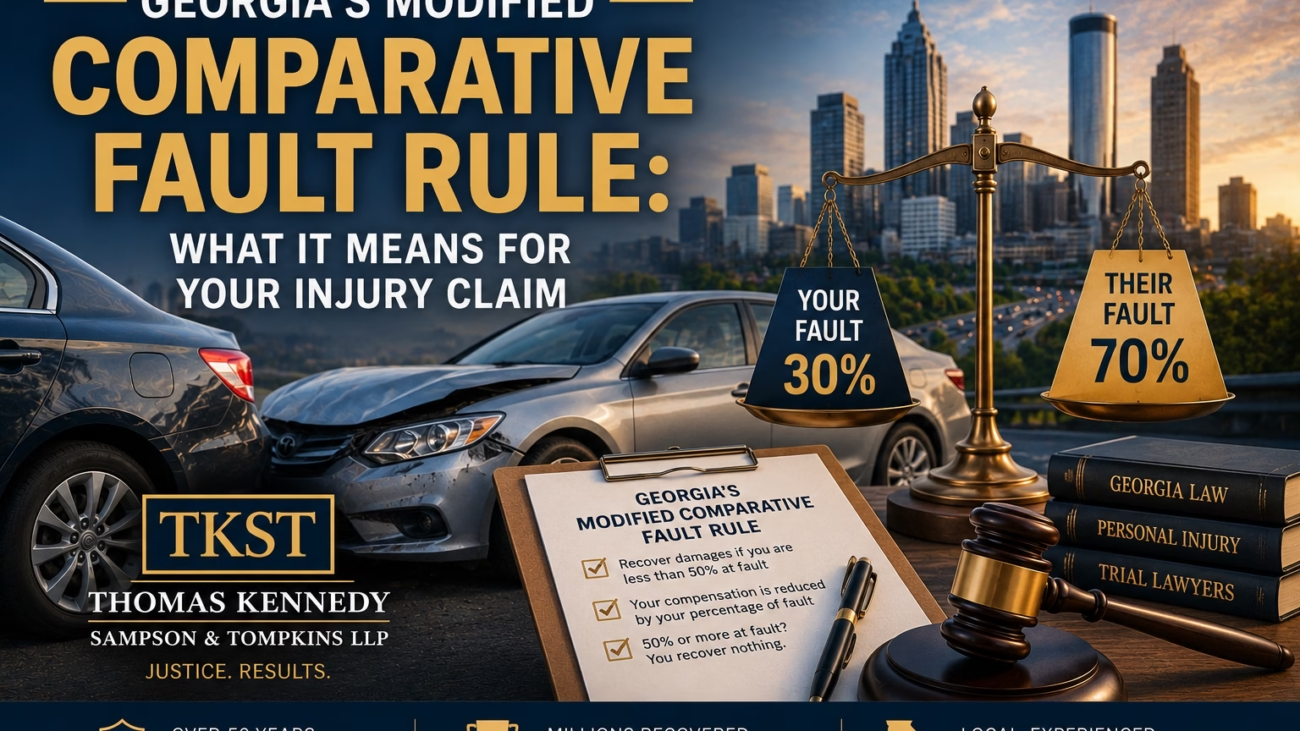
Georgia’s Modified Comparative Fault Rule — What It Means for Your Injury Claim

Quick Answer: Georgia follows a modified comparative fault rule under O.C.G.A. § 51-11-7. If you are partially at fault for an accident, your compensation is reduced by your percentage of fault. However, if you are found 50% or more at fault, you are completely barred from recovering any damages. This rule is one of the most aggressively used tools by insurance companies in Georgia — and understanding it could be the difference between a full recovery and no recovery at all.

After an accident, one of the first things an insurance adjuster will try to establish is whether you share any blame. It doesn’t matter if the other driver ran a red light, if a property owner left a dangerous condition unaddressed, or if a truck driver was fatigued behind the wheel. The insurer’s job is to minimize what they pay — and Georgia’s comparative fault rule is their favorite weapon to do it.

Understanding how this law works, how it gets applied in real cases, and how experienced Georgia trial attorneys protect clients against unfair fault assignments is essential knowledge for any injury victim in this state.

What Is Georgia’s Modified Comparative Fault Rule?

Georgia operates under a modified comparative fault system, codified at O.C.G.A. § 51-11-7. The law has two core principles:

Principle 1 — Proportional Recovery: If you are partially at fault for an accident, your damages are reduced in direct proportion to your share of fault.

Principle 2 — The 50% Bar: If you are found to be 50% or more at fault, you recover nothing. You are completely barred from bringing a claim.

How the Rule Works in Practice — Real Examples

Example 1 — Car Accident

You are driving through an intersection on a green light when another driver runs the red and strikes your vehicle. Your total damages amount to $200,000. The at-fault driver’s insurer argues you were 8 mph over the speed limit and assigns you 20% fault.

Your recovery: $200,000 × (1 − 0.20) = $160,000

This scenario plays out in car accident and auto accident cases every day across Georgia — and it’s the most common context where comparative fault arguments are raised.

Example 2 — Slip and Fall

You slip on a wet floor at a grocery store in Atlanta. Your injuries total $120,000. The store argues you weren’t paying attention. The jury assigns you 30% fault.

Your recovery: $120,000 × (1 − 0.30) = $84,000

Example 3 — The 50% Bar in Action

A pedestrian is struck by a vehicle while crossing outside a marked crosswalk. Total damages are $300,000. The jury finds the pedestrian 51% at fault.

Recovery: $0. The 50% bar eliminates the claim entirely.

How Insurance Companies Use This Rule Against You

Make no mistake: insurance adjusters are trained to use Georgia’s comparative fault rule strategically.

The Recorded Statement Trap: Adjusters call within days asking for a recorded statement. Questions are designed to get you to admit partial responsibility — which is then documented and used to inflate your fault percentage.

Early Low-Ball Offers: Quick settlement offers are quietly discounted to reflect an inflated fault percentage they’ve assigned you internally.

Manufactured Evidence: In serious cases, insurers hire accident reconstruction experts specifically to build a case that you share blame.

Comparative Fault Counterclaims: Defense attorneys routinely assert that the plaintiff bears significant responsibility — even in cases where the evidence clearly favors the victim. This is a pressure tactic to force lower settlements.

What Factors Determine Fault Percentage in Georgia?

In car accident cases:

  • Speed at the time of impact
  • Traffic signal and sign compliance
  • Distracted driving (phone use, eating, adjusting controls)
  • Following distance and right-of-way compliance
  • Driving under the influence

In premises liability cases:

  • Whether the hazard was visible and obvious
  • Whether the victim was paying reasonable attention
  • Whether posted warnings were present and visible

In truck accident cases:

  • Driver hours of service compliance
  • Vehicle maintenance records
  • Cargo loading and securement
  • Whether the victim was in the truck’s blind spot

Truck accident cases are particularly prone to comparative fault disputes because multiple parties — the driver, the trucking company, and the cargo loader — may each try to shift blame onto the victim or each other.

Georgia vs. Other Fault Systems

Fault SystemStatesKey Rule
Pure contributory negligenceAL, MD, NC, VA, DCAny fault by victim = zero recovery
Modified comparative (50% bar)Georgia + ~20 states50%+ fault = zero recovery
Modified comparative (51% bar)~30 states51%+ fault = zero recovery
Pure comparative faultCA, FL, NY + othersRecovery reduced regardless of fault %

Georgia’s 50% bar is stricter than the 51% bar used in many other states — a victim who is exactly 50% at fault in Georgia recovers nothing, while the same victim in a 51% bar state would still recover 50% of their damages.

The Role of Your Attorney in Fault Disputes

Preserving and Controlling Evidence: The moment TKST takes a case, we move to preserve all available evidence — surveillance footage, black box data, phone records, witness statements — before it is lost or spun by the other side.

Countering the Insurance Narrative: We retain our own accident reconstruction experts, medical experts, and vocational experts to build an independent, evidence-backed account of what happened.

Keeping You Off the Record: We advise clients from day one: do not give recorded statements to opposing insurance companies. Do not post about the accident on social media.

Taking the Case to Trial When Necessary: At Thomas Kennedy Sampson & Tompkins LLP, we have been trying cases in Georgia courtrooms for over 50 years. Our attorneys have secured 7- and 8-figure results in cases where fault was aggressively disputed by the defense.

Special Situations Where Comparative Fault Gets More Complex

Multiple Defendants: When more than one party is at fault, Georgia’s comparative fault principles apply across all responsible parties. An experienced attorney will identify and pursue all liable defendants.

Employer Liability: If the at-fault party was acting within the scope of their employment — a delivery driver, a company vehicle operator — their employer may share liability, opening the door to the employer’s insurance policy and assets.

Government Entities: Claims against Georgia state or local government entities involve special procedures under the Georgia Tort Claims Act (O.C.G.A. § 50-21-20 et seq.), including mandatory ante litem notice requirements with very short deadlines.

Wrongful Death Cases: In Georgia wrongful death claims, the comparative fault of the deceased can still be raised as a defense by the defendant — one of the most painful aspects of these cases.

Frequently Asked Questions

Can I still file a personal injury claim in Georgia if I was partially at fault?

Yes — as long as you were less than 50% at fault, you can still recover damages. Your recovery is reduced by your fault percentage. For example, if you were 30% at fault and your damages are $100,000, you recover $70,000.

What happens if I am found exactly 50% at fault in Georgia?

Under O.C.G.A. § 51-11-7, being found 50% at fault bars you from any recovery. The threshold is strict — you must be less than 50% at fault to recover anything.

Who decides how much fault I bear — a judge or a jury?

In cases that go to trial, fault percentage is determined by the jury. In cases that settle before trial, it is effectively negotiated between the parties and their attorneys.

Can the insurance company just decide I’m 50% at fault and deny my claim?

An insurer can take that position internally, but they cannot unilaterally impose a legal finding of fault. If you dispute their determination, the matter can be litigated and a jury can make the actual fault finding.

Does Georgia’s comparative fault rule apply to all types of personal injury cases?

Yes — it applies across car accidents, truck accidents, slip and fall claims, premises liability, product liability, and most other personal injury case types.

How does comparative fault affect a wrongful death claim in Georgia?

The comparative fault of the deceased can be raised as a defense in a Georgia wrongful death case. If proven, it reduces the damages the surviving family can recover by the decedent’s percentage of fault.

The Bottom Line: Fault Is Not Fixed — It Is Fought For

Georgia’s modified comparative fault rule is a battleground where insurance companies fight to reduce or eliminate what they owe injury victims. At Thomas Kennedy Sampson & Tompkins LLP, we have spent over five decades protecting Georgia injury victims from exactly this kind of insurance strategy.

If you have been injured in Georgia and someone is arguing you share the fault, do not accept that position without getting a second opinion from an experienced trial lawyer.

Talk to a Georgia Personal Injury Attorney — Free Consultation

The sooner you speak with an attorney after an accident, the better your chances of preserving evidence and controlling the fault narrative before the other side shapes it. Consultations are free and you pay nothing unless we win your case.

Call us today: (404) 688-4503

Free case evaluation: tkst-triallawyers.com/contact-us

This article is for informational purposes only and does not constitute legal advice.