
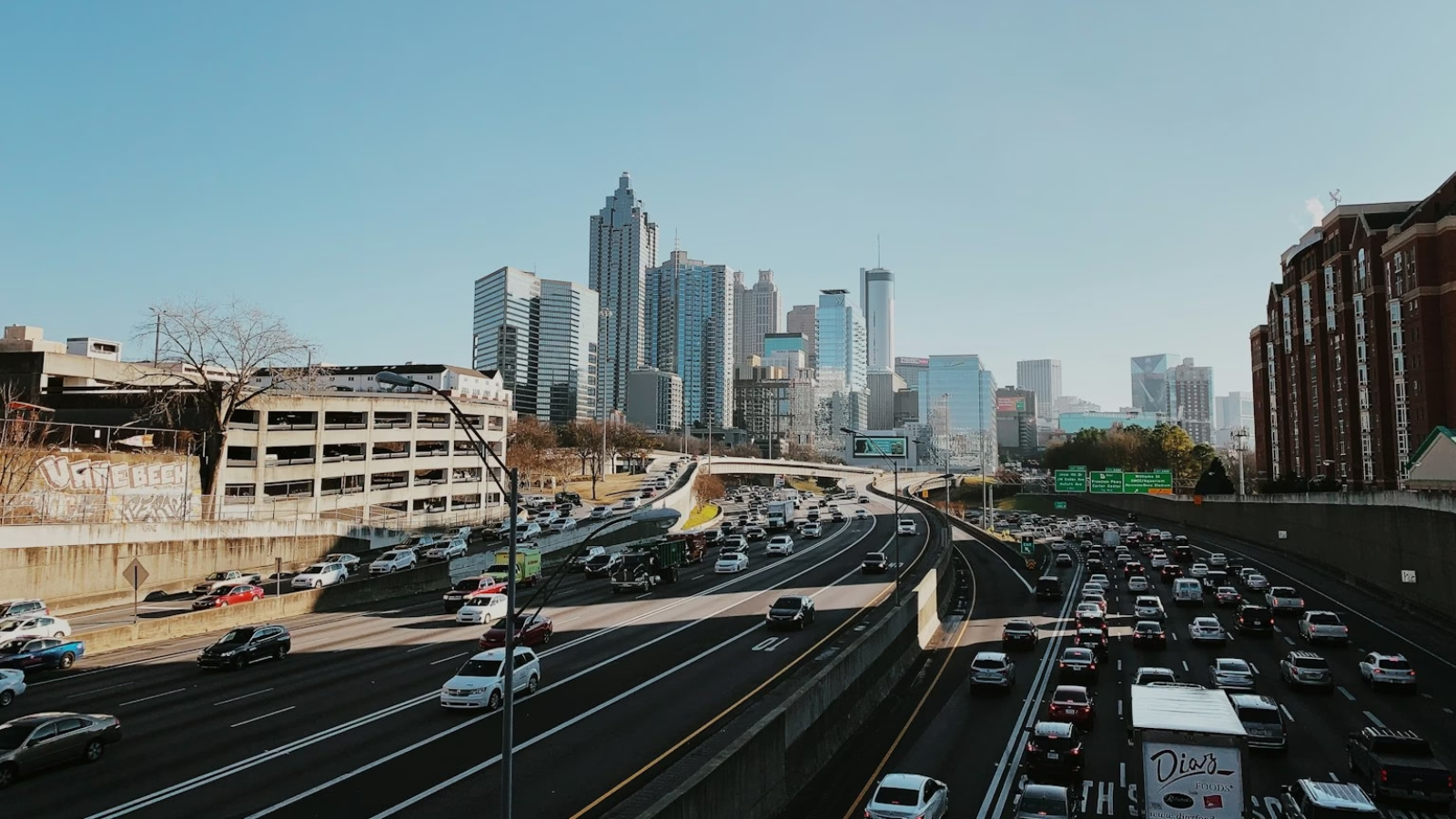
Every driver in Atlanta knows the Downtown Connector, the stretch where I-75 and I-85 merge into one roadway and run together past Downtown and Midtown before splitting again at Brookwood. It is the spine of the city. It is also the single most crash-prone piece of pavement most Atlantans will ever drive.
What makes the Connector dangerous is not driver skill. It is geometry and volume. A short roadway is asked to carry an enormous number of vehicles, give them more than a dozen places to get on and off, and let them cross several lanes to do it. Collisions are the predictable result.
If you were hurt in a wreck on the Connector, here is what actually drives these cases.
Quick answer
The Downtown Connector is the shared stretch of I-75 and I-85 through Downtown and Midtown Atlanta. GDOT planning work has put daily volume on the busiest segment above 400,000 vehicles, among the heaviest in the country, and roughly 60 percent of that traffic is local rather than through traffic.
Most Connector crashes are rear-end and sideswipe collisions caused by closely spaced ramps, left-hand exits and sudden stop-and-go slowdowns. Under Georgia law your recovery is reduced by your share of fault and barred entirely at 50 percent, so proving how the collision actually unfolded is what decides the value of the claim.
What Makes the Connector Different From Any Other Road in Georgia
Two interstates sharing one roadbed is unusual. Combining that with a downtown street grid feeding on and off it is close to unique.
- Volume in a confined space. Georgia Department of Transportation planning studies have measured daily traffic above 400,000 vehicles at the busiest point. That is interstate volume squeezed through an urban corridor.
- It is a local road, not just a through route. GDOT found roughly 60 percent of Connector traffic is local trips, not people passing through Georgia. Drivers are entering and exiting constantly rather than settling into a lane.
- Closely spaced ramps. Entrances and exits arrive every few blocks. A driver who needs to move from an on-ramp to an exit on the far side has very little distance to do it.
- Left-hand exits. The Connector has exits on the left, which violates what most drivers expect. Traffic crossing from the right lanes to a left exit cuts directly against traffic crossing the other way.
- Stop-and-go at interstate speeds. Traffic repeatedly collapses from highway speed to a standstill and back. The gap between a driver watching the road and one looking at a phone becomes the difference between stopping and not.
- Permanent construction. Lane shifts, narrowed shoulders and changing patterns mean the road a driver remembers is not always the road in front of them.
The Crash Patterns We See Most, and the Evidence That Proves Them
Connector cases tend to fall into a handful of recognizable patterns. Each one is won or lost on a different kind of proof.
| Crash pattern | Why it happens here | Evidence that decides it |
|---|---|---|
| Rear-end in sudden slowdowns | Traffic collapses without warning and following distances are far too short for the speed | Dashcam video, damage pattern, phone records, 511 and GDOT camera footage of the slowdown |
| Sideswipe during lane changes | Drivers crossing multiple lanes to reach closely spaced or left-hand exits | Point of impact on each vehicle, paint transfer, lane position in camera footage, witness statements |
| Merge and ramp collisions | Short acceleration lanes force vehicles to join fast traffic at low speed | Scene photographs showing ramp geometry, sight distance analysis, vehicle speeds |
| Work zone crashes | Shifted lanes, narrowed shoulders and inconsistent signage | Traffic control plans, contractor records, signage photographs, the responsible agency or contractor |
| Secondary crashes | A first incident stops traffic and following drivers strike the queue | Incident timeline, HERO and dispatch logs, position of each vehicle in the queue |
| Wrong-way entries at night | Ramp confusion, often combined with impairment | Toxicology, ramp signage, surveillance from nearby businesses |
Who Can Be Held Responsible
The other driver is the starting point, not the whole picture. A serious Connector crash often has more than one responsible party, and finding all of them is what gets a badly injured person fully compensated.
- The at-fault driver and their insurer. Georgia is an at-fault state, a system we explain in our guide on how Georgia’s at-fault car insurance system affects your injury claim.
- An employer, where the driver was working. Delivery vehicles, service vans and company cars are everywhere on this road, and a commercial policy is usually far larger than a personal one.
- A trucking company. Commercial trucks on the Connector bring federal regulations and corporate defendants into the case. See our truck accident practice and our guide to who is liable in a truck accident in Georgia.
- A rideshare company, through the coverage layers described on our Uber and Lyft accident page.
- Your own insurer, through uninsured and underinsured motorist coverage, which often matters most when the at-fault driver carries minimum limits or leaves the scene. If the driver fled, see our hit and run practice.
- A government entity or contractor, where roadway design, signage or a work zone contributed. Those claims carry much shorter deadlines, covered in our guide to the six month ante litem notice for claims against the City of Atlanta.
Injuries From Connector Crashes Are Often Severe
People assume a crash in slow traffic is a minor crash. On the Connector the speed differential is what causes the harm: a vehicle traveling at highway speed striking a stopped queue produces the same forces as any high-speed collision. The cases our firm handles from this corridor regularly involve traumatic brain injuries, spinal cord injuries, burn injuries where fuel systems rupture, and other catastrophic injuries. When a family loses someone, they may bring a wrongful death claim.
What to Do After a Crash on the Connector
- Get out of the live lanes if you safely can. Shoulders on this road are narrow and sometimes absent. Secondary crashes injure people who are standing beside their cars.
- Call 911 and note which agency responds. Georgia State Patrol and Atlanta Police both work this corridor, and the agency determines where the report lives.
- Photograph before the scene is cleared. HERO operators clear the Connector fast, and the physical evidence disappears with the vehicles.
- Get checked the same day. Adrenaline hides head and spine injuries, and a gap in treatment is the first thing an adjuster uses to discount a claim.
- Do not give a recorded statement to the other driver’s insurer before you have advice. Our guide on what to do immediately after a car accident in Atlanta walks through the rest.
How Georgia Apportionment Decides What You Actually Recover
Multi-vehicle crashes are where Georgia’s fault rules bite hardest. Under O.C.G.A. section 51-12-33, a jury reduces your award by your own percentage of fault, and you recover nothing if you are found 50 percent or more at fault. The statute also lets the jury assign fault to people who were never sued, provided the defense gives notice at least 120 days before trial.
In practice that means a defendant in a five-car Connector pileup will try to spread the blame across every other driver involved, including you. Our guide to Georgia’s modified comparative fault rule explains the mechanics, and how much a personal injury case is worth in Georgia covers how that percentage translates into dollars.
Frequently Asked Questions
Why are there so many crashes on the Downtown Connector?
The Connector carries extremely heavy volume through a short, dense stretch of road where I-75 and I-85 share the same lanes. Georgia Department of Transportation planning work has put daily traffic on the busiest segment above 400,000 vehicles. Add closely spaced entrances and exits, left-hand exits, constant lane changing and long periods of stop-and-go traffic, and you get frequent rear-end and sideswipe collisions at speeds high enough to cause real injuries.
Who responds to a wreck on I-75/I-85 through Downtown Atlanta?
Georgia State Patrol works many interstate crashes, and Atlanta Police also respond to incidents inside the city limits. GDOT HERO operators are often on scene first to clear lanes and protect the area. Which agency writes the report affects how you request it, so note the responding agency and the case number before you leave.
I was rear-ended in stop-and-go traffic. Is the other driver automatically at fault?
Not automatically, although following too closely is a common and provable cause. Georgia assigns fault by percentage, so the other driver may argue you stopped suddenly, changed lanes without signaling or had non-working brake lights. Photographs, dashcam video and the vehicle damage pattern are what settle the question.
Can I recover if the crash was partly my fault?
Yes, as long as your share of the fault is less than 50 percent. Under Georgia apportionment law your damages are reduced by your percentage of fault, and you recover nothing if you are 50 percent or more responsible.
What if a road defect or a work zone caused the crash?
A claim involving roadway design, signage, lane markings or a construction work zone may involve GDOT, the City of Atlanta or a contractor. Government claims carry notice deadlines far shorter than the usual two years, so those cases need to be identified early.
How long do I have to file a claim after a Downtown Connector crash?
Georgia generally allows two years from the date of injury for a personal injury or wrongful death lawsuit. If a government entity may be responsible, a written ante litem notice is due in six months for a city and twelve months for a county or the state, which is why these cases should be reviewed quickly.
Related Reading
- What to Do Immediately After a Car Accident in Atlanta, GA
- Truck Accidents on I-285 and at Spaghetti Junction
- Car Accidents Around Hartsfield-Jackson Atlanta International Airport
- Georgia’s Modified Comparative Fault Rule
- How Long Do You Have to File a Personal Injury Claim in Georgia?
- Atlanta Car Accident Lawyers
Talk to an Atlanta Car Accident Lawyer About Your Connector Crash
Thomas Kennedy Sampson & Tompkins LLP has represented injured Georgians for more than 50 years from our office in the Atlanta metro, serving Fulton, DeKalb, Clayton, Cobb and Gwinnett counties. We know how multi-vehicle interstate cases are defended and how quickly the evidence that proves them is cleared away.
Call (404) 688-4503 or request a free consultation. You pay nothing unless we recover for you.
Sources and References
- Georgia Department of Transportation, the state highway agency responsible for the Downtown Connector: dot.ga.gov
- Justia, published text of Georgia’s apportionment statute O.C.G.A. section 51-12-33: law.justia.com
- Justia, published text of the municipal ante litem notice statute O.C.G.A. section 36-33-5: law.justia.com
- U.S. Bureau of Labor Statistics, Census of Fatal Occupational Injuries, national data on roadway incidents: bls.gov
This article is general information about Georgia law and is not legal advice. Every case turns on its own facts. Reading this page does not create an attorney-client relationship.

Add a Comment