
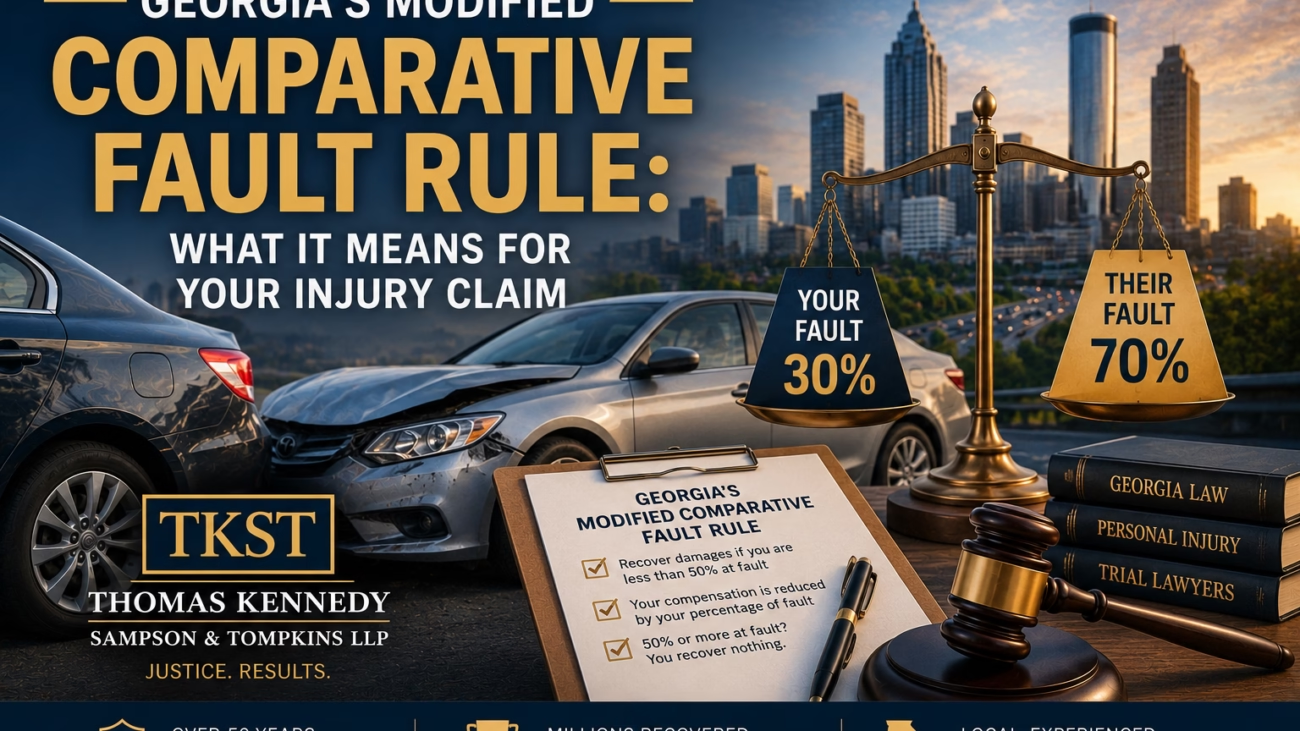
| Quick Answer: Georgia follows a modified comparative fault rule under O.C.G.A. § 51-11-7. If you are partially at fault for an accident, your compensation is reduced by your percentage of fault. However, if you are found 50% or more at fault, you are completely barred from recovering any damages. This rule is one of the most aggressively used tools by insurance companies in Georgia — and understanding it could be the difference between a full recovery and no recovery at all. |
After an accident, one of the first things an insurance adjuster will try to establish is whether you share any blame. It doesn’t matter if the other driver ran a red light, if a property owner left a dangerous condition unaddressed, or if a truck driver was fatigued behind the wheel. The insurer’s job is to minimize what they pay — and Georgia’s comparative fault rule is their favorite weapon to do it.
Understanding how this law works, how it gets applied in real cases, and how experienced Georgia trial attorneys protect clients against unfair fault assignments is essential knowledge for any injury victim in this state.
What Is Georgia’s Modified Comparative Fault Rule?
Georgia operates under a modified comparative fault system, codified at O.C.G.A. § 51-11-7. The law has two core principles:
Principle 1 — Proportional Recovery: If you are partially at fault for an accident, your damages are reduced in direct proportion to your share of fault.
Principle 2 — The 50% Bar: If you are found to be 50% or more at fault, you recover nothing. You are completely barred from bringing a claim.
How the Rule Works in Practice — Real Examples
Example 1 — Car Accident
You are driving through an intersection on a green light when another driver runs the red and strikes your vehicle. Your total damages amount to $200,000. The at-fault driver’s insurer argues you were 8 mph over the speed limit and assigns you 20% fault.
Your recovery: $200,000 × (1 − 0.20) = $160,000
This scenario plays out in car accident and auto accident cases every day across Georgia — and it’s the most common context where comparative fault arguments are raised.
Example 2 — Slip and Fall
You slip on a wet floor at a grocery store in Atlanta. Your injuries total $120,000. The store argues you weren’t paying attention. The jury assigns you 30% fault.
Your recovery: $120,000 × (1 − 0.30) = $84,000
Example 3 — The 50% Bar in Action
A pedestrian is struck by a vehicle while crossing outside a marked crosswalk. Total damages are $300,000. The jury finds the pedestrian 51% at fault.
Recovery: $0. The 50% bar eliminates the claim entirely.
How Insurance Companies Use This Rule Against You
Make no mistake: insurance adjusters are trained to use Georgia’s comparative fault rule strategically.
The Recorded Statement Trap: Adjusters call within days asking for a recorded statement. Questions are designed to get you to admit partial responsibility — which is then documented and used to inflate your fault percentage.
Early Low-Ball Offers: Quick settlement offers are quietly discounted to reflect an inflated fault percentage they’ve assigned you internally.
Manufactured Evidence: In serious cases, insurers hire accident reconstruction experts specifically to build a case that you share blame.
Comparative Fault Counterclaims: Defense attorneys routinely assert that the plaintiff bears significant responsibility — even in cases where the evidence clearly favors the victim. This is a pressure tactic to force lower settlements.
What Factors Determine Fault Percentage in Georgia?
In car accident cases:
- Speed at the time of impact
- Traffic signal and sign compliance
- Distracted driving (phone use, eating, adjusting controls)
- Following distance and right-of-way compliance
- Driving under the influence
In premises liability cases:
- Whether the hazard was visible and obvious
- Whether the victim was paying reasonable attention
- Whether posted warnings were present and visible
In truck accident cases:
- Driver hours of service compliance
- Vehicle maintenance records
- Cargo loading and securement
- Whether the victim was in the truck’s blind spot
Truck accident cases are particularly prone to comparative fault disputes because multiple parties — the driver, the trucking company, and the cargo loader — may each try to shift blame onto the victim or each other.
Georgia vs. Other Fault Systems
| Fault System | States | Key Rule |
| Pure contributory negligence | AL, MD, NC, VA, DC | Any fault by victim = zero recovery |
| Modified comparative (50% bar) | Georgia + ~20 states | 50%+ fault = zero recovery |
| Modified comparative (51% bar) | ~30 states | 51%+ fault = zero recovery |
| Pure comparative fault | CA, FL, NY + others | Recovery reduced regardless of fault % |
Georgia’s 50% bar is stricter than the 51% bar used in many other states — a victim who is exactly 50% at fault in Georgia recovers nothing, while the same victim in a 51% bar state would still recover 50% of their damages.
The Role of Your Attorney in Fault Disputes
Preserving and Controlling Evidence: The moment TKST takes a case, we move to preserve all available evidence — surveillance footage, black box data, phone records, witness statements — before it is lost or spun by the other side.
Countering the Insurance Narrative: We retain our own accident reconstruction experts, medical experts, and vocational experts to build an independent, evidence-backed account of what happened.
Keeping You Off the Record: We advise clients from day one: do not give recorded statements to opposing insurance companies. Do not post about the accident on social media.
Taking the Case to Trial When Necessary: At Thomas Kennedy Sampson & Tompkins LLP, we have been trying cases in Georgia courtrooms for over 50 years. Our attorneys have secured 7- and 8-figure results in cases where fault was aggressively disputed by the defense.
Special Situations Where Comparative Fault Gets More Complex
Multiple Defendants: When more than one party is at fault, Georgia’s comparative fault principles apply across all responsible parties. An experienced attorney will identify and pursue all liable defendants.
Employer Liability: If the at-fault party was acting within the scope of their employment — a delivery driver, a company vehicle operator — their employer may share liability, opening the door to the employer’s insurance policy and assets.
Government Entities: Claims against Georgia state or local government entities involve special procedures under the Georgia Tort Claims Act (O.C.G.A. § 50-21-20 et seq.), including mandatory ante litem notice requirements with very short deadlines.
Wrongful Death Cases: In Georgia wrongful death claims, the comparative fault of the deceased can still be raised as a defense by the defendant — one of the most painful aspects of these cases.
Frequently Asked Questions
Can I still file a personal injury claim in Georgia if I was partially at fault?
Yes — as long as you were less than 50% at fault, you can still recover damages. Your recovery is reduced by your fault percentage. For example, if you were 30% at fault and your damages are $100,000, you recover $70,000.
What happens if I am found exactly 50% at fault in Georgia?
Under O.C.G.A. § 51-11-7, being found 50% at fault bars you from any recovery. The threshold is strict — you must be less than 50% at fault to recover anything.
Who decides how much fault I bear — a judge or a jury?
In cases that go to trial, fault percentage is determined by the jury. In cases that settle before trial, it is effectively negotiated between the parties and their attorneys.
Can the insurance company just decide I’m 50% at fault and deny my claim?
An insurer can take that position internally, but they cannot unilaterally impose a legal finding of fault. If you dispute their determination, the matter can be litigated and a jury can make the actual fault finding.
Does Georgia’s comparative fault rule apply to all types of personal injury cases?
Yes — it applies across car accidents, truck accidents, slip and fall claims, premises liability, product liability, and most other personal injury case types.
How does comparative fault affect a wrongful death claim in Georgia?
The comparative fault of the deceased can be raised as a defense in a Georgia wrongful death case. If proven, it reduces the damages the surviving family can recover by the decedent’s percentage of fault.
The Bottom Line: Fault Is Not Fixed — It Is Fought For
Georgia’s modified comparative fault rule is a battleground where insurance companies fight to reduce or eliminate what they owe injury victims. At Thomas Kennedy Sampson & Tompkins LLP, we have spent over five decades protecting Georgia injury victims from exactly this kind of insurance strategy.
If you have been injured in Georgia and someone is arguing you share the fault, do not accept that position without getting a second opinion from an experienced trial lawyer.
Talk to a Georgia Personal Injury Attorney — Free Consultation
The sooner you speak with an attorney after an accident, the better your chances of preserving evidence and controlling the fault narrative before the other side shapes it. Consultations are free and you pay nothing unless we win your case.
Call us today: (404) 688-4503
Free case evaluation: tkst-triallawyers.com/contact-us
This article is for informational purposes only and does not constitute legal advice.